I walked around my place, unsure what to do. My contract had ended unexpectedly right before Christmas. It was about the worst time to look for work, and I had surgery in two months further complicating the job search.
I immediately went to Halifax. Never been. Always wanted to go. A friend met me there and I had a great time. Once back, I was a bit at a loss.
I had a “no buy” policy to save money; so pretty much all outings were out. My extended friend network didn’t really do stuff together anymore as we aged; instead favoring the intimacy of their home and partners. My closest friends were at work and school. Winter had come and I only had a bus pass to get around. I got into a routine: yoga on YouTube, good coffee, job search, walking to the library / around, reading, video games.
I was bored out of my mind. I yearned to be around people. Where can you hang out without expectations of paying in downtown Ottawa during winter? It’s really just the library.
I ended up getting a job, at least for now, but I still dream of common spaces. Big venues in the center of the city, with a large library, free concerts, poetry shows, communal gardens, free chili/tea, work spaces, maker spaces, and green spaces to lay down for picnics, with plenty of natural light. Where everyone, from affluent urban parents with young children, to the elderly, to those with significant visible mental health issues, to those who experience great levels of poverty, are all able to feel safe and enjoy and use the space equally.
This week the Vancouver Public Library is at the center of outcry over its hosting of Meghan Murphy’s event. She is perhaps the highest profile transphobe in Canada along with Jordan Peterson. The VPL said in its statement following the negative attention:
VPL is not endorsing, or hosting this event; it is a rental of our public space. VPL has zero tolerance for discrimination and does not agree with the views of the Feminist Current. However, commitment to free speech and intellectual freedom are fundamental values of public libraries and are bedrock values for democratic society. As such, we will not refuse to rent to an individual or organization simply because they are discussing controversial topics or views, even those we find offensive. We seek to be a welcoming place for all, and actively find ways to support the trans, gender variant and two-spirit communities.
Media relations director Althea Blackburn-Evans said Peterson “has the right to express his views,” but that faculty members “also have responsibilities to create a learning environment at the University of Toronto that’s free from discrimination.
“The university’s mandate is to foster discussion and debate around topics that can often be very controversial,” Blackburn-Evans said.
In both cases these venues portrayed themselves as neutral and against discrimination. On this I wish to be clear:
Debates are not neutral.
Hosting speakers is not a neutral gesture.
We know this, because had the speaker been a Neo-Nazi, the VPL and U of T wouldn’t have given them a platform. It isn’t a violation of free speech to decline to give a platform to bigotry, but it is a choice.
It is inconsistent to insist they oppose discrimination while playing a key part in promulgating beliefs that a particular segment of society should be denied fundamental rights. It is no coincidence that the people making such statements on behalf of these institutions are not those targeted by this vitriol.
Part of what is going on here, I believe, is this myth that debates are neutral. That speech does not contribute to discrimination. That we live in a society of unfettered free speech. That the right side wins in the battle of ideas. That discrimination is a thing of the past, or a thing that takes place over there, or a case of individuals acting badly.
It ignores that for groups that are marginalized, the side to win these debates in the beginning is the side that argues to further ostracize them. The view of those with power, be it on women’s rights, gay rights, trans rights, sex worker rights, indigenous rights, always starts off opposed. Eventually, but certainly not always as we see with indigenous rights an sex workers, there is a shift. During that transition, a lot of people continue to be opposed to rights. So when you inject a platform for people to argue to support this marginalization during this period of transition, it carries heft. People listen. This doesn’t take place in a void and so people act on what they hear. Those acts are legal – most discrimination is. And it can do a lot of damage.
Jordan Peterson rose to fame specifically on the basis of his transphobic views amplified by Canadian and American media. So it happens now that I sit down at a restaurant, and I overhear the man at the table next to me share with great enthusiasm to the person across from him Jordan Peterson’s view on gender. That man, and those like him, are embolden through this validation to treat people like me worse. These views are validated and legitimized through their association with institutions like the University of Toronto and the Vancouver Public Library. They thought it was okay, so it’s okay for me too, right?
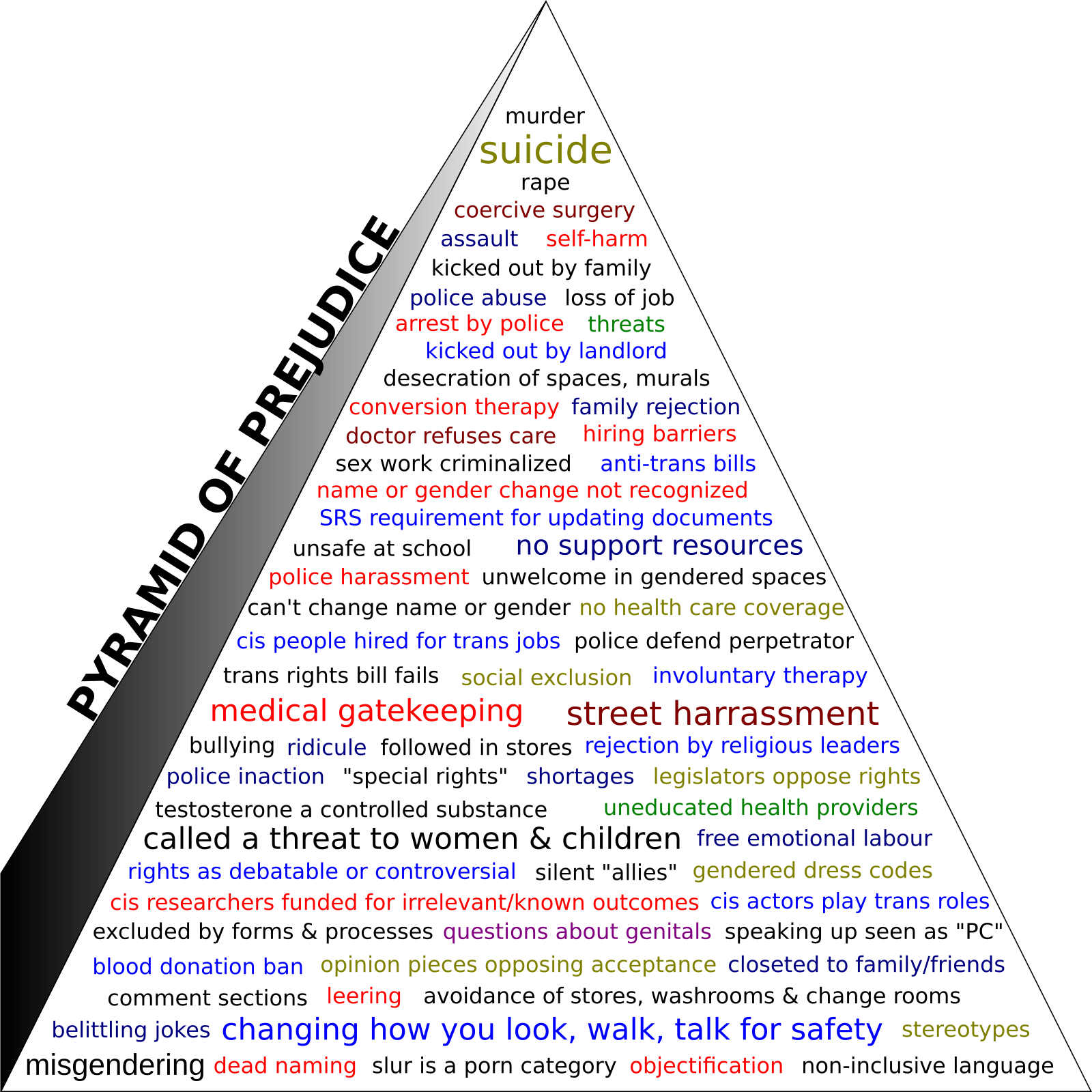
To the cis people heading these institutions, it’s harmless free speech. It’s harmless to them that’s for sure. But to me, it’s adding to the bottom tier of the discrimination pyramid, lowering the bar for the harsher acts that follow.
This is a short article in which I want to note two emergent traits I have observed in trans activism.
The traits can be summarized as such:
An entitlement by privileged trans people co-opting the hardships of others
A framing of trans rights as only being about gender identity
An entitlement by privileged trans people co-opting the hardships of others
The entitlement I’ve observed is especially true of trans people who are white, financially secure, have supportive families, have recently transitioned (post 2008, and especially post 2014) and lack dependents. They co-opt the statistics of trans people of colour and lived of experiences of poor trans people, passing off their hardships as their own. They wield their privilege and co-opted identity to divest resources and recognition from those who do far more. They do experience discrimination, but lack the awareness to appreciate their relative privilege.
A framing of trans rights as only being about gender identity
Under this framing, equality is reached when trans identities are normalized. This narrative ignores the ways that trans people have been systemically prevented from a safe and secure existence. In this framing of trans rights as being about gender identity, the following topics are avoided:
Poverty reduction
Housing as a right
Sex work as work
Living wages
Rights for precarious workers
Reduction in unionized workers
Police brutality
HIV criminalization
Rape culture
Free tuition
Good public transit
Physical access to spaces
Drug use criminalization
Colonialism
I believe these topics are avoided because the discussions around trans rights are led by the privileged trans people mentioned previously. They have not experienced the systemic discrimination that the statistics they coopt refer to, and therefore fail to take these factors into account when discussing the marginalization of trans people.
While there are thousands of peer reviewed articles and a multitude of medical organisations that support the acceptance of trans people, there are also a handful of articles and medical professionals that are in opposition. Yet this handful is over-represented in newspapers and television. After hearing mental health professionals inquire about both the Swedish Study and Rapid Onset Gender Dysphoria at a training session, I thought I’d address them here.
How Opponents Use It: “A 2011 long term Swedish study that followed a 30-year trajectory of 324 people who had sex reassignment surgery found that suicide rates 10 years after surgery were 20 times that of the non-trans population… Surely it is the government’s first responsibility to try to prevent suicides rather than to validate emotive claims made by those least capable of assessing their condition with objectivity.” Source.
The leading author of the 2011 study, Cecilia Dhejne, has also spoken out against the interpretation of her research by opponents. She said “People who misuse the study always omit the fact that the study clearly states that it is not an evaluation of gender dysphoria treatment. If we look at the literature, we find that several recent studies conclude that WPATH Standards of Care compliant treatment decrease gender dysphoria and improves mental health.”
How Opponents Use It: “Dr. Littman describes the condition experienced by these girls as “rapid-onset gender dysphoria” (ROGD). It develops during or soon after puberty and mainly affects girls with no previous signs of childhood gender dysphoria . According to the study, parents say that many girls do have a history of mental illness, and some are on the autism spectrum. The most controversial element of Dr. Littman’s research is her claim that ROGD spreads via social and peer contagion. While the incidence of gender dysphoria in the general population is quite low – less than 1 per cent – it’s not uncommon for two or more girls in the same friendship group – or even half of them – to begin to identify as transgender. ROGD also spreads by social media according to Dr. Littman; some parents describe their daughters binge-watching YouTube transition videos.” Source.
What’s Wrong About It: The study did not speak to or collect any data from trans youth for this paper on trans youth. The author surveyed 256 parents recruited from websites advocating against the acceptance of trans youth. The children described were 82% assigned female at birth and some were as old as 27. The author appears to conflate the gender dysphoria being new to the parent as being new to the child, calling it rapid onset gender dysphoria.
Following criticism, PLOS One, the journal that published the paper, released a statement stating that it would “seek further expert assessment on the study’s methodology and analyses. We will provide a further update once we have completed our assessment and discussions.”
Brown University, where the study’s author is based, released its own statement saying “After the research paper was published in the Journal PLOS ONE, concerns were raised about the paper’s research design and methodology by leading academics in the field… Given the concerns about research design and methods — not the controversial nature of the subject — the University decided to stop featuring this news story on its news site.”
How Opponents Invoke Them: “Let’s say it were possible to take a 10-year-old kid and make them either a well-adjusted lesbian or turn them into a female-to-male transsexual,” Blanchard told Rogan. “I don’t see anything wrong with saying it’s better to make this kid into a lesbian, because being a lesbian doesn’t require breast amputation, the construction of a not-very-convincing false penis, and a lifetime of testosterone shots.” Source.
“We urge them to say, ‘Let’s figure out what other things you can do besides play with that doll,’” Zucker says. “In some situations, we have to work hard with parents’ own issues about gender. Could be a mother who’s had difficulty with the men in her life and has a lot of mixed feelings toward men. That gets translated to the boy, and her fear that he’ll grow up to be like those men causes him to reject being a boy.” Source.
“The trans movement is crossing ethical lines with a particularly vulnerable subset of young people struggling with issues of gender identity,” writes Susan Bradley. “A recent article by Elise Ehrhard in Crisis Magazine, a Catholic periodical, addresses the aggressive approach by adult trans activists in recruiting adolescents with Asperger’s Syndrome or other types of Autism Spectrum Disorder (ASD) to their cause.” Source.
In 2016, The New Atlantis published McHugh’s article “Sexuality and Gender“. The current faculty at John Hopkins disavowed McHugh’s article citing that it “was not published in the scientific literature, where it would have been subject to rigorous peer review prior to publication” and that it “mischaracterizes the current state of the science on sexuality and gender.” While The New Atlantis purports to be a scientific journal, it is not peer reviewed, was founded by the conservative Ethics and Public Policy Center, and publishes articles like “The Population Control Holocaust” in apparent reference to birth control and abortion.
How Opponents Invoke Him: “HRC and other pro-LGBTQ organizations are trying to discredit McHugh because he is the most respected medical and psychiatric authority debunking transsexual “gender change” ideology, which includes recommending “sex reassignment” surgical reconstructions — even minors —of healthy sexual organs to imitate body characteristics of the opposite sex.” Source.
What’s The Deal: Previous to Jordan Peterson, arguments against trans rights centered around the bathroom predator myth. As the sexual predator argument was losing steam in the face of increasing acceptance for trans people, Peterson popularized a new argument: that human rights legislation would require people to use the right pronouns for non-binary individuals. He wrote of pronouns, “These words are at the vanguard of a post-modern, radical leftist ideology that I detest, and which is, in my professional opinion, frighteningly similar to the Marxist doctrines that killed at least 100 million people in the 20th century.” Peterson has never researched trans people.
How Opponents Invoke Him: “In the later years of Adolf Hitler’s Germany, the government made it compulsory for people to use the “Heil Hitler” salute in all public greetings. They risked prosecution, arrest and even death for refusing to do so… Prof. Peterson is facing intense criticism from students, professors and administrators for saying he will not use genderless pronouns (such as “they”) to refer to transgender students, if asked. … Forcing members of private organizations to call transgender people by the personal pronouns of their choosing is a form of conscripted speech.” Source.
How Opponents Invoke Them: “Dr. Michelle Cretella is Executive Director of the American College of Pediatricians who focused on children’s behavioral health as a general pediatrician. I asked her about the Brown University study, and the increase in children identifying as transgender… “Yes. Regarding transgender identification, social contagion is unleashed on teens via the internet, mainstream and social media, messaging in schools, peer pressure, and sadly, from the medical elites who propagandize gender ideology as science.””
Meanwhile: The evidence-based American Academy of Pediatrics has advocated to support trans youth stating “The American Academy of Pediatrics stands in support of transgender children and adults, and condemns attempts to stigmatize or marginalize them… The AAP supports policies that are gender-affirming for children – an approach that is supported by other key professional organizations.”
The National Post is one of two leading national newspapers in Canada. From 2011 to 2018, the National Post has released at least sixty editorials advocating against the acceptance of trans people. Most of these date from after 2014.
So I thought I would paint a picture of trans people, as depicted by the National Post. I’m doing so without commentary as I believe it’s more revealing this way.
Radical transactivists are guilty of the worst form of misogyny in their ruthless campaign to erase from our thoughts the human female body as a unique life form.
Such an absurdity — a woman literally redefined as a man or a woman — could be sloughed off as an over-reach if politicians, the justice system and school boards were not similarly complicit in enforcing compliance with this lie.
Whatever is going on in his mind and heart, a biological male “is” not a female. Two plus two “is” still four.
“Just because you lop off your dick and then wear a dress doesn’t make you a f***ing woman,” [Germaine Greer] said.
However, to be a woman involves a set of biological and social rites that someone who merely looks like a woman can never fully appreciate.
She objects to transgender men appropriating her gender and flaunting a surgically enhanced caricature of it. They are engaging in a fantasy of womanhood free of its dangers and pitfalls.
Ms Talackova, you will recall, is the surgically transgendered woman who successfully challenged the rules of the Miss Universe Canada contest when she was rejected according to the rules disallowing transsexuals.
I should think that amongst the diminishing coterie of non-ideologues for whom beauty contests still hold significance, Ms Talackova’s presence was a joke. A joke, mind you, they have been well trained in political correctness enough to understand they mustn’t laugh out loud at, but a joke nonetheless.
Mocking the transgender argument that people are whatever gender they feel they are — male, female, something in between, or none of the above — Clark refuses to concede longstanding facts of life: “Men don’t have vaginas or female anatomy … and women don’t have penises,” he says.
I finally figured it out: the Vanity Fair cover of Caitlyn Jenner represents none of what matters about women, and lots of what harms us. That a man — athletic, accomplished, successful — can, in 2015, announce to the world: “I’ve decided to become a woman,” and then go on to proudly present herself as a corseted, puffed-and-buffed bimbo whose only credentials as a woman are breasts and professional makeup. What’s worse: people are taking it seriously.
As Mark Steyn puts it in a deeply insightful column analyzing the new tyranny of trans correctness, Caitlyn is neither man nor woman – “she’s a transwoman – a new, separate … category…
By her family, Caitlyn is a woman, and by her 10 million Twitter followers, Caitlyn is a woman… But by doctrinaire feminists – and I never thought I would say this, but they seem to me, in terms of ideological integrity, to be the brave ones in this affair – she’s not a woman.
And it’s instructive to contrast Dolezal’s fate for saying she feels black with that of Bruce Jenner for saying he feels like a woman.
It perfectly captures the modern spirit of narcissistic relativism. And once you abolish truth you never find a stopping place. Social change is a process not a destination. But once “Caitlyn” Jenner has been lionessized on the cover of Vanity Fair, what frontiers remain?
And if you can change your sex just by saying “Ecce femina” why not your race while you’re at it? And your height.
It’s an odd world. Glamour magazine recently named the former Bruce Jenner as its Woman of the Year. … In this context, coming out is simply to be understood as an act of self-declaration. If a person self-identifies as X, Y or Z, then he, she, ze or hir has to be what he, she, ze or hir professes to be. If it’s a nightmare for grammarians, just think of the chaos in biology departments.
“I’ve asked my doctor to give me long ears and liver spots and I’m going to wear a brown coat but that won’t turn me into a fucking cocker spaniel,” [Germaine Greer] said.
I have a chicken-and-egg theory about the whole trans phenomenon we are witnessing. It only took off in a big way when the chemical means became available to artificially mimic the opposite sex in self-presentation. In other words, the notion that one was born in the wrong body only became a social contagion when the look of the assumed identity could be approximated via medication.
From Sex and the troubled mind (Original title: Gender issues are a matter of sex and the troubled mind):
It has become politically incorrect to suggest that transgenderism or transsexualism is anything more than an alternate lifestyle … In the new parlance, “normal” is not how people are born biologically, it is whatever they think they are.
…we should lend our efforts to research that will lead to a cure for this terribly sad psychological problem.
But, barely pausing to celebrate their victory on gay marriage, the identity-group enforcers have gone full steam ahead on transgender issues.
Having done an impressive job of demolishing the basic societal building block of the family, the ambitious liberal is now moving on to demolishing the basic biological building block of the sexes.
Biological homelessness — “gender identity disorder” in the jargon — is a very real, biologically rooted condition, but it is nothing to celebrate or encourage.
Yet the message we are getting from academics and pedagogues fixated on gender equality is that biological ambiguity should be valorized and even encouraged, at any rate certainly not discouraged.
“Let’s say it were possible to take a 10-year-old kid and make them either a well-adjusted lesbian or turn them into a female-to-male transsexual,” Blanchard told Rogan. “I don’t see anything wrong with saying it’s better to make this kid into a lesbian, because being a lesbian doesn’t require breast amputation, the construction of a not-very-convincing false penis, and a lifetime of testosterone shots.”
A trans child coming out is cause for parents not to accept them (and parents are the victims here)
“Out of the blue,” never having shown signs of gender dysphoria before puberty, a girl announces she is trans.
Many parents, influenced by a bullishly trans-supportive cultural environment … offer uncritical support for transitioning. By contrast, the skeptical parents think medicalization is too drastic for what could be a transient phase, and resist. What happens to them isn’t pretty.
Imagine yourself the parent of an adolescent boy or (more likely) girl without a single previous sign of body dysphoria, who “out of the blue” decides she is transgender.
Parents often felt betrayed by the unprofessional attitudes of clinicians they consulted: psychologists, pediatricians, gender therapists and endocrinologists. Many were resistant to exploring other sources of distress, or hostile to parental testimony regarding their children’s fabrications.
Their parents felt confused at what appeared to them to be a sudden change in their daughters.
Their experiences align with accounts by parents of “trans” kids on the blog, 4thwavenow.com, described as “a community of parents and friends skeptical of the ‘transgender/child/teen’ trend.”
Almost invariably, these teenagers spend an inordinate amount of time on certain websites, notably Tumblr and Reddit. Here they can find advice on how to lie to clinicians: “Get a story ready in your head … keep the lie to a minimum” and “look up the DSM for the diagnostic criteria for transgender and make sure your story fits it.”
She found reviewing Reddit, SubReddit and Tumblr comments very troubling. Disparagement of heterosexuals and “cisgenders” is rife. Contempt for parents is encouraged. Feelings of victimhood are promoted.
I have a chicken-and-egg theory about the whole trans phenomenon we are witnessing. It only took off in a big way when the chemical means became available to artificially mimic the opposite sex in self-presentation. In other words, the notion that one was born in the wrong body only became a social contagion when the look of the assumed identity could be approximated via medication.
Linda had resisted affirming her daughter’s decision to transition because of its suddenness, and because the daughter had a history of other psychological issues. She voiced her concerns to the group, expressing her opinion that [Rapid Onset Gender Dysphoria] was a “social contagion” rather than a true identity. Linda said she would not support medical intervention.
One reinforces the theory that [Rapid Onset Gender Dysphoria] can be a form of “social contagion.” (In one case study, a 14-year-old natal female and three of her natal female friends announced they were transgender within a year of a popular coach’s announcement that she was transgender.)
Trans people are exploiting children (with sex education)
The trans movement is crossing ethical lines with a vulnerable subset of youth struggling with issues of gender identity.
A recent article by Elise Ehrhard in Crisis Magazine, a Catholic periodical, addresses the aggressive approach by adult trans activists in recruiting adolescents with Asperger’s Syndrome or other types of Autism Spectrum Disorder (ASD) to their cause.
Sex merging is especially present in domains where pre-sexual children are ripe for indoctrination.
At the gender-neutral Egalia pre-school in Stockholm, staff avoid using words like “him” or “her” and address the 33 kids as “friends” rather than girls and boys.
Ideologues applaud these bizarre initiatives, but I don’t know any ordinary person, including myself, who is not appalled by this absurd and dangerous impulse toward social engineering.
SOGI 123 [curriculum supplement on sexual orientation and gender identity] represents a sectarian belief system, whose advocates seek normalization of the statistically rare phenomenon of irreversible gender dysphoria through an unproven concept — despite the assertions of transactivist militants, there is no scientific evidence to suggest that biology and gender are unlinked — that can cause psychological harm to children.
I predict a surge toward home-schooling by parents who refuse to allow their children’s minds to be exploited as pedagogical guinea pigs.
B.C., it is clear, does not view schools as a place in which children are taught the basic tools necessary to navigate life – math, science, geography – but as petri dishes for social experimentation in which teachers are lab technicians with unwitting children as their mice.
On Monday, the Vancouver School Board approved a policy change aimed at accommodating gender identity and sexual orientation. … Parents who questioned the change argued, quite reasonably, that six-year-olds aren’t qualified to understand all the intricacies of identity issues.
This is abundantly clear in the third grade of the Ontario sex-ed curriculum, where children are introduced to the thought-experiment that their gender identity may be at odds with their biological sex. They can be a male trapped in a female body, and vice versa.
The moral and psychological and health implications of this experimental teaching alone would be worthy of a parental revolt. The suicide rates for trans people rises above 40 per cent.
Yet even purely intellectually speaking, the public education establishment is involved in disseminating what can only be termed propaganda.
Much of what children are learning about transgenderism today, at a very tender age, is not science-based, but activist-dictated theory that can result in psychological harm.
Advertisement run in the National Post on September 24, 2011. The Post apologized a week later following complaints, stating the ad among other things singled “out of a specific group of people who have made choices about their sexuality with which the group disagrees”.
Meanwhile, they’ve observed “the mental health and social relationships of children with [Rapid Onset Gender Dysphoria] get much worse once they adopt transgender identities,”
And they are correct, as many apparently transgender children accept their biological identity at puberty, and many adults express regret over their surgeries.
Of the 324 surgical patients studied, the suicide rate was 20 times the non-transgender population.
A 2011 long term Swedish study that followed a 30-year trajectory of 324 people who had sex reassignment surgery found that suicide rates 10 years after surgery were 20 times that of the non-trans population.
Surely it is the government’s first responsibility to try to prevent suicides rather than to validate emotive claims made by those least capable of assessing their condition with objectivity.
Trans women should be prohibited from women’s washrooms
Transactivists bristle at the very idea that girls and women may be at risk in single-sex environments when biological males have access to them.
A Sept. 2 article in The Sunday Times states the newspaper’s own investigation showed that “(a)lmost 90 per cent of reported sexual assaults, harassment and voyeurism in swimming pool and sports-changing rooms happen in unisex facilities, which make up less than half the total.”
On a practical level, there may well be concerns with allowing biologically male or female children to use a communal bathroom belonging to the opposite sex, and the NDP should respect a school’s discretion on this point.
So the apparent message is that if you want to have a career, even start one, stay away from anyone espousing what have very suddenly become intolerable views on gender like that men shouldn’t pee in the girls’ bathroom.
But Trent has instituted a policy of gender-neutral washrooms, and Brown balks at sharing intimate space with members of the biologically opposite sex. She discovered that expression of her discomfort is more than unwelcome on her campus; it has literally become a forbidden opinion.
To conclude on a personal note, from what I understand of Transparent’s Maura, she would have been perfectly happy to pee in a designated single-stall bathroom, physical relief, not tyranny over others, being her objective.
Because of a settlement reached four years ago in a case brought to the Ontario Human Rights Commission in 2013, the Ontario Hockey Federation, the governing body for most of minor hockey in the province, has now trained its coaches in gender diversity…
If only Jesse Thompson … wouldn’t have needed to file a human rights complaint — and now, there wouldn’t be a whole new set of rules and regs tailored to 0.7 per cent of the population with issues that were only ever a problem for 0.7% of the hockey population.
I think a mandatory pronoun check-in is regrettable because of the emphasis on difference as opposed to an emphasis on oneness — that we are all the same.
Then transgender rights came along and within a couple of years we had people born male racing in women’s track events and heading feminist organizations, and academic censorship of opposing views. Can it really keep going like this?
It’s okay to disclose the genitals of trans people to an international audience without their consent
I can’t even get my head around what it must be like trying to determine what “they” want for dinner; it must be like an endless game of who’s-on-first.
I find it precious to be asked to call a single human being by a plural pronoun, I would, if asked. (I wouldn’t write it that way, however, because it just gets stupid. See what-do-you-want-for-dinner, above.)
I would not use what have come to be known as “preferred pronouns” to refer to people who believe that their gender does not fit neatly into the traditional categories of male and female.
I will never use words I hate, like the trendy and artificially constructed words “zhe” and “zher.” These words are at the vanguard of a post-modern, radical leftist ideology that I detest, and which is, in my professional opinion, frighteningly similar to the Marxist doctrines that killed at least 100 million people in the 20th century.
Finally, it is absurd to insist that each person should have the right to, or could practically, choose their own pronouns.
I have and continue to urge against and dismiss as absurd and outrageous the demand that those who purport to be in a transgender condition that is neither male nor female, have a right to be addressed in a new vocabulary of their devising.
Bryson’s official profile on the UBC site uses the pronoun “they” to refer to her, as in, “Throughout Mary’s 27 years at UBC, they have served in many senior administrative roles…” I take from this that “they” is her preferred pronoun, but I decline to use it.
“Ze” for he or she and “Zir” in place of his or him are the sticking points, but what is accumulating behind these imbecilic distinctions is quite sinister.
But no individual or group has the right to invent a new vocabulary and a new co-equal gender because of a state of ambivalence or confusion about which sex they are.
On Thursday, the Senate passed Bill C-16, the Liberal government’s legislation that adds “gender identity or expression” to grounds of discrimination in the Canadian Human Rights Act.
Few Canadians realize how seriously these statutes infringe upon freedom of speech.
In other words, failure to use a person’s pronoun of choice — “ze,” “zir,” “they” or any one of a multitude of other potential non-words — will land you in hot water with the commission. That, in turn, can lead to orders for correction, apology, Soviet-like “re-education,” fines and, in cases of continued non-compliance, incarceration for contempt of court.
Prof. Peterson is facing intense criticism from students, professors and administrators for saying he will not use genderless pronouns (such as “they”) to refer to transgender students, if asked.
Forcing members of private organizations to call transgender people by the personal pronouns of their choosing is a form of conscripted speech.
The aim of the exercise is to remove any hint of gender from the language. It’s the goal of people who feel that being identified as male or female is a trap, or a prison, and wish to break free. They do not “identify” as either of the conventional genders, and feel their perspective should be recognized and respected by others, and that the language should be adapted to suit their needs.
If the language can be bent to suit every individual preference, it ceases to have rules and becomes yet another victim of political purity, as dictated by whatever identity group has the megaphone today.
The cowardice of the regime limped to the aid of the winner of the media and public relations contest, as the University of Toronto did last year when transgender groups tried to force Peterson to address them in a special vocabulary, the words “he, she, and you” being somehow disrespectful.
The older, raw, honest tyrannies told people what not to speak. But the new, wilier versions, midwifed by our famous human rights overseers, are proposing to insist on what we must speak. Here be the new axioms of our day: we own your pronouns, use no others. “He” and “she” are assault words. Freedom of speech is the life-raft flotsam of gurgling obscurantists and bigots going down for the last time.
He’s a hurricane of fresh air, this university professor who baldly says that one of the many reasons he won’t adopt the faddish new non-binary gender pronouns is that “the people who made those words are possessed by ideology and not to be trusted anyway.”
The recent controversy over Professor Jordan Peterson’s refusal to mouth the latest neologisms for transgenders — the “xe, xir, xem” and the like — earned for him accusations of being “transphobic.” I think any fair reading of Peterson’s arguments utterly deflate that accusation.
Accentuating the differences of a group already afflicted by feelings of being outcast, through inventing and mandating the use of discriminative gender identifiers, will only exacerbate feelings of ostracism.
In the later years of Adolf Hitler’s Germany, the government made it compulsory for people to use the “Heil Hitler” salute in all public greetings. They risked prosecution, arrest and even death for refusing to do so.
Prof. Peterson is facing intense criticism from students, professors and administrators for saying he will not use genderless pronouns (such as “they”) to refer to transgender students, if asked.
Forcing members of private organizations to call transgender people by the personal pronouns of their choosing is a form of conscripted speech.
I will never use words I hate, like the trendy and artificially constructed words “zhe” and “zher.” These words are at the vanguard of a post-modern, radical leftist ideology that I detest, and which is, in my professional opinion, frighteningly similar to the Marxist doctrines that killed at least 100 million people in the 20th century.
Bill C-16 [adds “gender identity or expression” to grounds of discrimination in the Canadian Human Rights Act] is dangerous legislation. Those who formulated it and who are pushing it and its sister legislation are dangerous people.
In his writings on totalitarianism, George Orwell powerfully exposed the link between the manipulation of language and the erosion of individual liberty. Ideologues understand that linguistic control precedes, and is crucial to, political and cultural power. The novel 1984 illuminated the shame in being compelled — figuratively — to endorse the lie that two plus two is five.
Categorization is the basis of knowledge. Whatever is going on in his mind and heart, a biological male “is” not a female. Two plus two “is” still four.
Shepherd had created a “toxic climate” and an “unsafe learning environment,” and had violated the university’s “gender and violence policy,” and had incited “gender-based transphobia” by presenting, with contrary argument, the views of Peterson.
The inquisitors falsely described Peterson as a “white supremacist” who “targeted and harassed” transgender students and incited “transphobia” in a manner that is illegal under human rights legislation.
The cowardice of the regime limped to the aid of the winner of the media and public relations contest, as the University of Toronto did last year when transgender groups tried to force Peterson to address them in a special vocabulary, the words “he, she, and you” being somehow disrespectful.
It’s a harsh word, but “totalitarian” is the mot juste to describe governments that use their power — and public resources — to enforce ideological agreement with the maximum leader. That is exactly what the federal Liberals are doing in imposing an ideological test and coerced speech upon the Canada Summer Jobs Program.
But now, in order to qualify, the federal department of employment demands that the “organization’s core mandate respect … the right to access safe and legal abortions … and the rights of gender-diverse and transgender Canadians.” If you refuse the loyalty oath to Liberal party policy, you can’t apply.
On Thursday, the Senate passed Bill C-16, the Liberal government’s legislation that adds “gender identity or expression” to grounds of discrimination in the Canadian Human Rights Act.
Few Canadians realize how seriously these statutes infringe upon freedom of speech.
In other words, failure to use a person’s pronoun of choice — “ze,” “zir,” “they” or any one of a multitude of other potential non-words — will land you in hot water with the commission. That, in turn, can lead to orders for correction, apology, Soviet-like “re-education,” fines and, in cases of continued non-compliance, incarceration for contempt of court.
He’s a hurricane of fresh air, this university professor who baldly says that one of the many reasons he won’t adopt the faddish new non-binary gender pronouns is that “the people who made those words are possessed by ideology and not to be trusted anyway.”
He was influenced by the likes of Russian novelist Aleksandr Solzhenitsyn and psychiatrist and Holocaust survivor Viktor Frankl and “more peripherally by people like (the former Czech Republic president) Vaclav Havel, who noted very carefully the tight causal relationship between the pathologizing of everyday language and the degeneration of societies into authoritarian states.”
C-16 amended the Criminal Code to extend protection against “hate propaganda” to any segment of the public “distinguished by gender identity or expression,” and made “bias, prejudice, or hate based on gender identity or expression an aggravating circumstance when it is a motivating factor in a crime.”
As Senator Linda Frum tweeted: “Proponents of Bill C-16, including Justice Minister [Wilson-Raybould], testified that Bill C-16 could not be used as a tool to silence reasonable free speech. Yet here we are just a few Orwellian months later.”
For gender Marxists, pronouns are the latest patch of hotly contested terrain in the ongoing revolution.
Being compelled to validate someone else’s unsupported hypothesis by using what he believes are meaningless words, offends Peterson intellectually (and is sure to offend many religious people: “male and female He created them”).
Peterson is also prepared for an eventual trial in front of a human rights tribunal. Such a show trial would be a perfect object lesson in “velvet totalitarianism,” a trope coined decades ago by recently deceased University of Toronto psychology professor emeritus John Furedy.
In deference to transgender activists’ opposition to binary gender categories, her bill replaces most uses of the words “mother” and “father” in Ontario law, substituting for them “birth parent” and “parent.”
Clark calls Bill 28 “the Handmaid’s Tale Act,” referencing Margaret Atwood’s dystopian novel in which women are coerced into bearing children for infertile theocratic elites. That’s because it “literally rewrites motherhood and fatherhood,” he says. “In fact, it redefines motherhood out of existence.”
There are increasingly eerie parallels to our own time. For instance, in [Brave New World], the words “father” and “mother” are taboo, vulgar, even obscene. As recently as 2002 I felt Huxley was straining to make a point here. Yet politically correct government forms now forbid these terms as oppressive to gays, the transgendered and what have you.
Before classes even started last fall, teachers underwent serious “gender training” given by QMUNITY, an organization for LGBTQQ2S (lesbian, gay, bisexual, trans, queer, questioning and two-spirit) people. Teachers were told in no uncertain terms, for instance, that “no one is 100-per-cent male or female” and that everyone is somewhere on the “gender spectrum.”
What happened to the teacher over the ensuing few days sounds like something out of the Cultural Revolution in Mao’s China, where people were subjected to what were known as ideological struggle sessions, forced to “confess” to various imagined sins before large crowds, and roundly denounced.
Everyone is entitled to their opinions, Pimlott said, but the university has a “duty to make sure we’re not furthering … Jordan Peterson.”
They were oblivious to the fact that they themselves were proving him right by holding the 2017 equivalent of the “struggle sessions” so beloved in Mao’s China.
The older, raw, honest tyrannies told people what not to speak. But the new, wilier versions, midwifed by our famous human rights overseers, are proposing to insist on what we must speak. Here be the new axioms of our day: we own your pronouns, use no others. “He” and “she” are assault words. Freedom of speech is the life-raft flotsam of gurgling obscurantists and bigots going down for the last time.
In my observation … the least “vulnerable” and “marginalized” people on campuses today … are those in the trans community. Their professors, the administration and equity officers are falling over themselves to make life “safe” for them. We saw proof of that in the Maoist “struggle session” Lindsay Shepherd experienced. Her interrogators demonstrated that they consider “transphobia” to be an egregious thoughtcrime.
Meanwhile advocating for genocide of trans people should be permissible
But the advocating-genocide-against-any identifiable-group business was interesting. It was just recently, via Bill C-16, that “gender identity” and “gender expression” were added to the Canadian Human Rights Code and the criminal code.
With the criminal code, it means the section against hate propaganda — this is the one under which advocating genocide falls — is similarly enlarged to include the tiny percentage of people who don’t have the same gender identity as their biological sex.
No wonder Peterson raised the alarm.
Defy the stultifying parameters around public discussion that exist in this suffocating country at your peril.
It’s harder being transphobic now
From Sex and the troubled mind (Original title: Gender issues are a matter of sex and the troubled mind):
It has become politically incorrect to suggest that transgenderism or transsexualism is anything more than an alternate lifestyle … In the new parlance, “normal” is not how people are born biologically, it is whatever they think they are.
It is increasingly difficult for those studying transgender issues to report any findings that challenge the progressive narrative.
They have had the integrity to explore sexual variation in all its complexity, but have been stymied by transgender turf warriors bent on imposing an absolutist dogma that chills scientific and therapeutic progress.
But, thanks to aggressive activism in the trans movement, today any interventions to prevent gender transitioning in children is deemed by LGBT loyalists — and increasingly by legislators — as insensitive or even abusive. Ontario’s 2015 Bill 77, for example, bans funding for “any services rendered that seek to change or direct the sexual orientation or gender identity of a patient, including efforts to change or direct the patient’s behaviour or gender expression.”
Gender politics is putting a chill on objective research and psychiatrists’ ability to offer reasonable clinical help to distraught families.
Referenced articles
A total of 60 editorials published by the National Post with anti-trans commentary were selected for this article. The oldest editorial dates from 2011, the vast majority were published from 2014 until now (September 2018).