I’m currently spending lots of my time questioning how I see myself, in particular in relation to my body. I identify as male, that lines up with my sex, I use male pronouns, and have a mostly masculine gender expression. I don’t expect that to change. Nevertheless, there are parts of me that really don’t jive with that. So I’m exploring.
If I divulged that on this blog, it means that I had been thinking something for a while and I thought it might go somewhere. Of the three main digital platforms I write about myself in, this blog is the most sanitized. Prospective employers read this, for instance, so anything too personal is usually omitted. For me to then talk about gender incongruity was a big step.
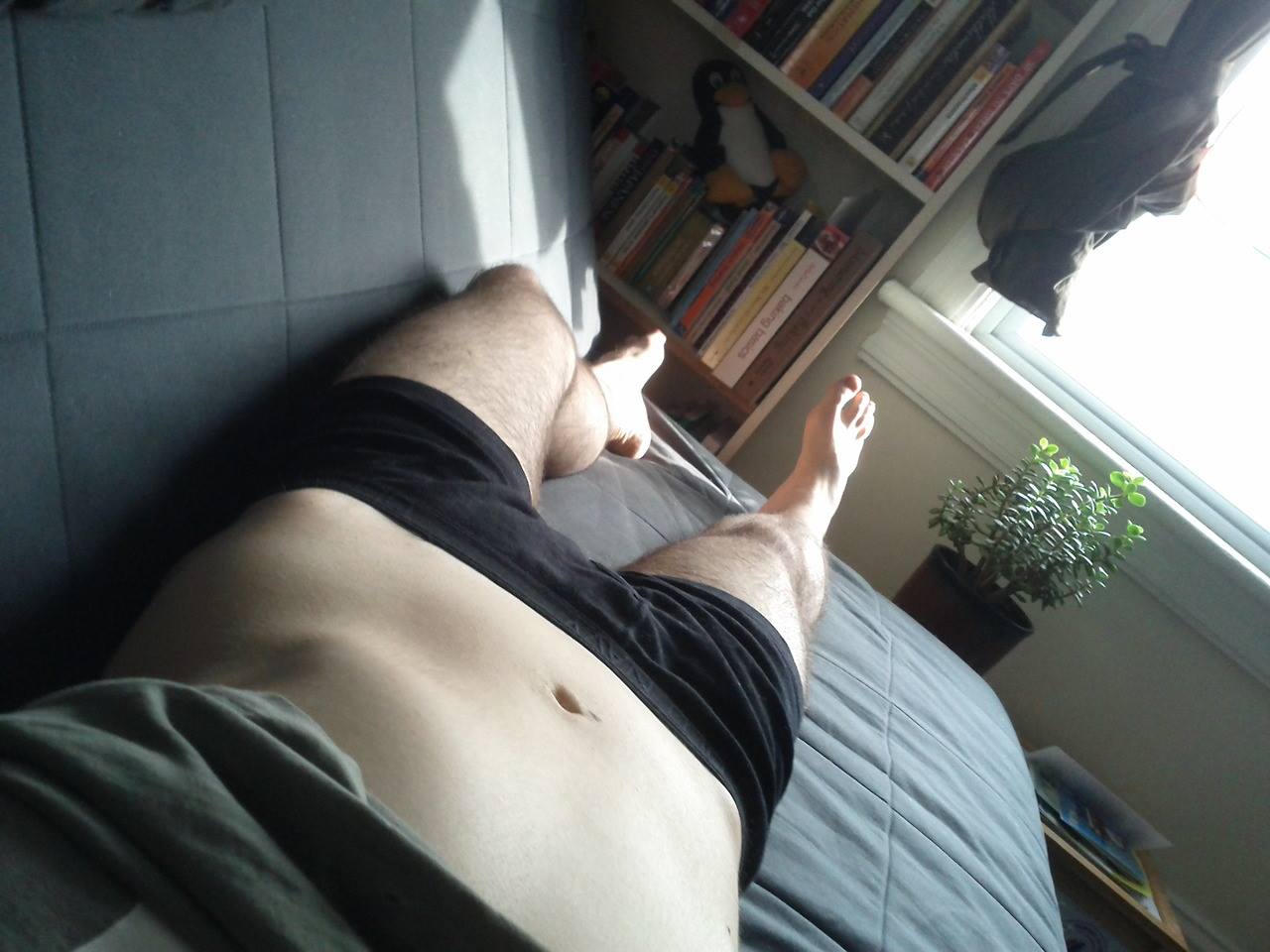
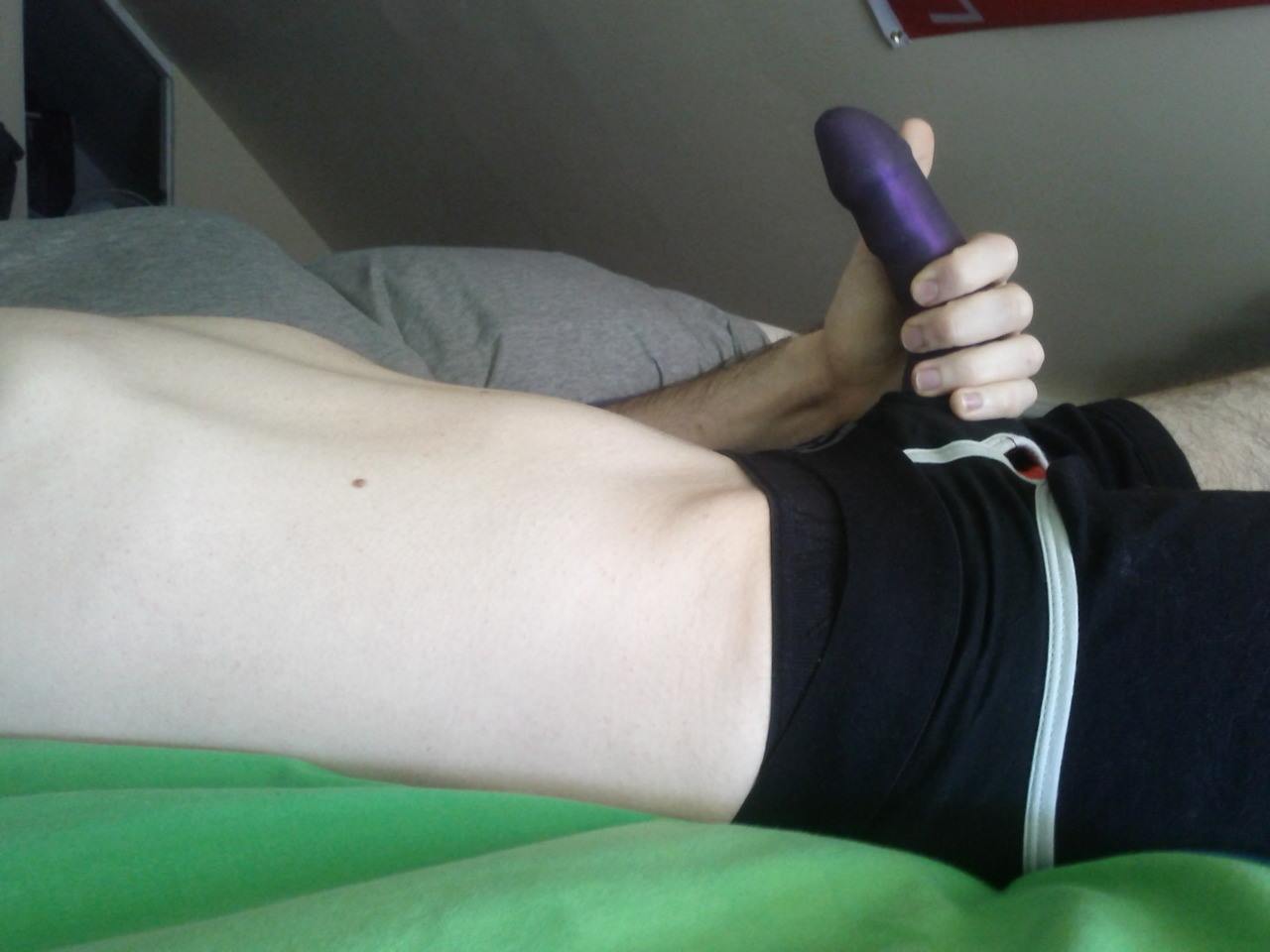
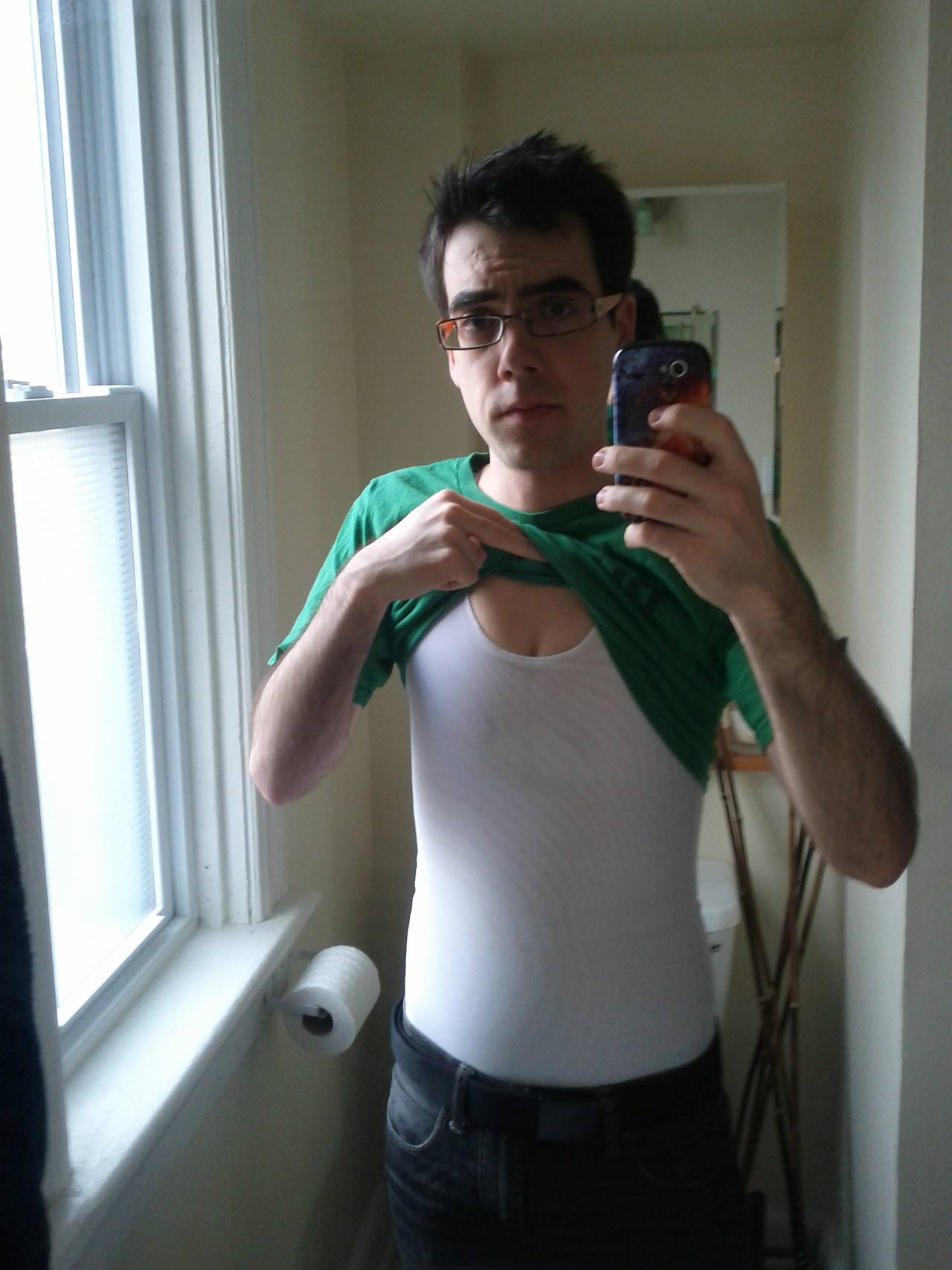
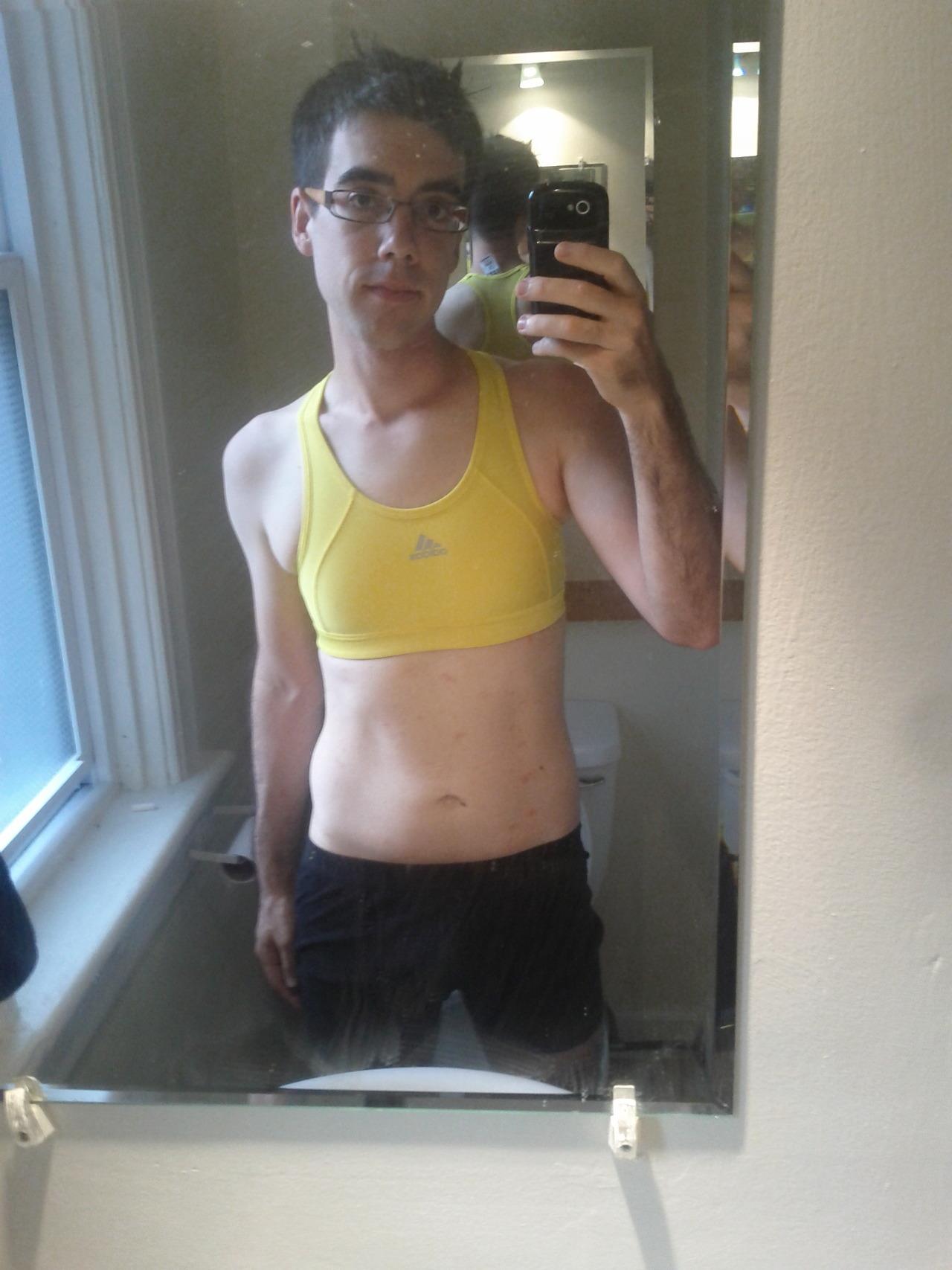
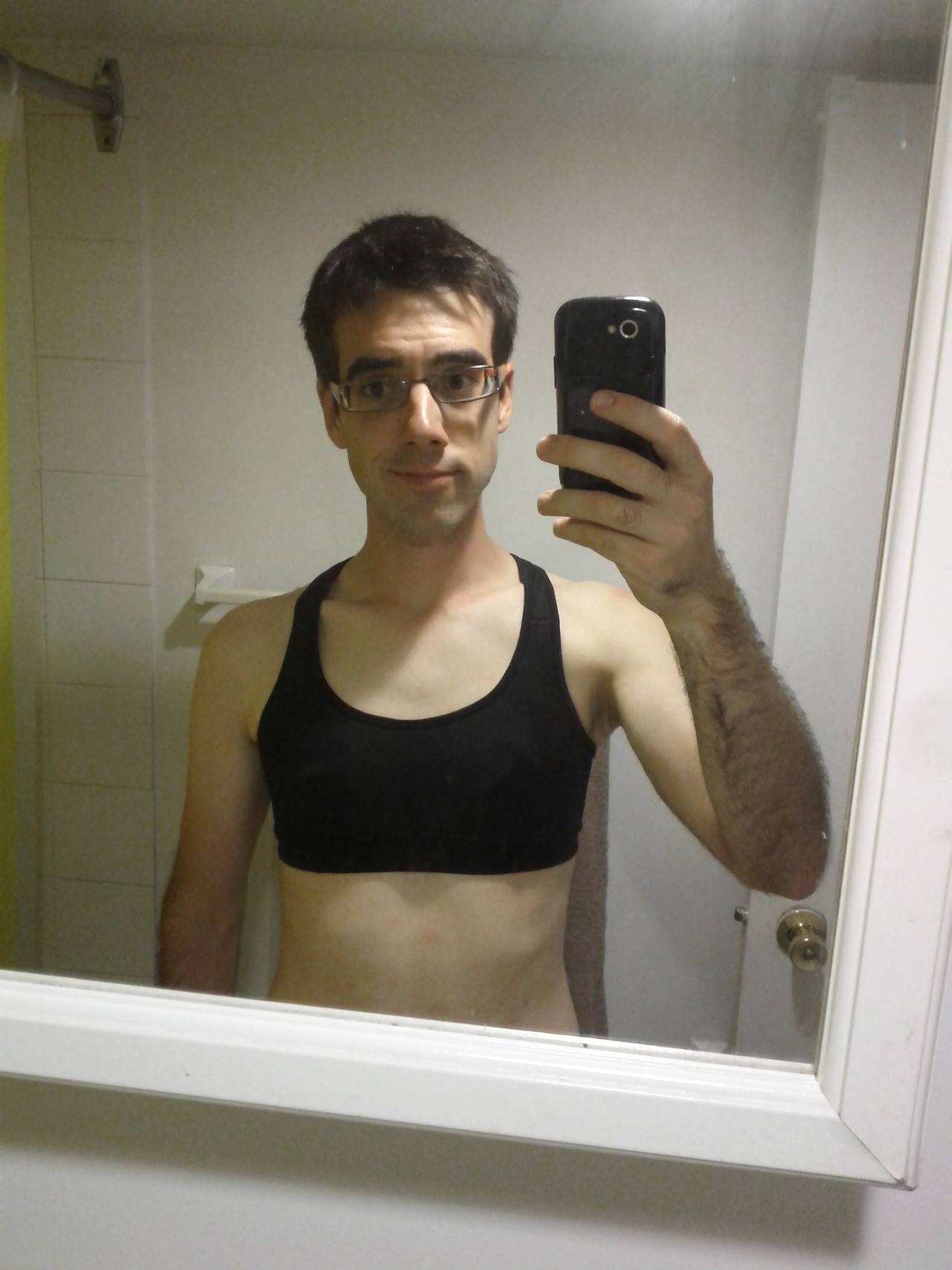
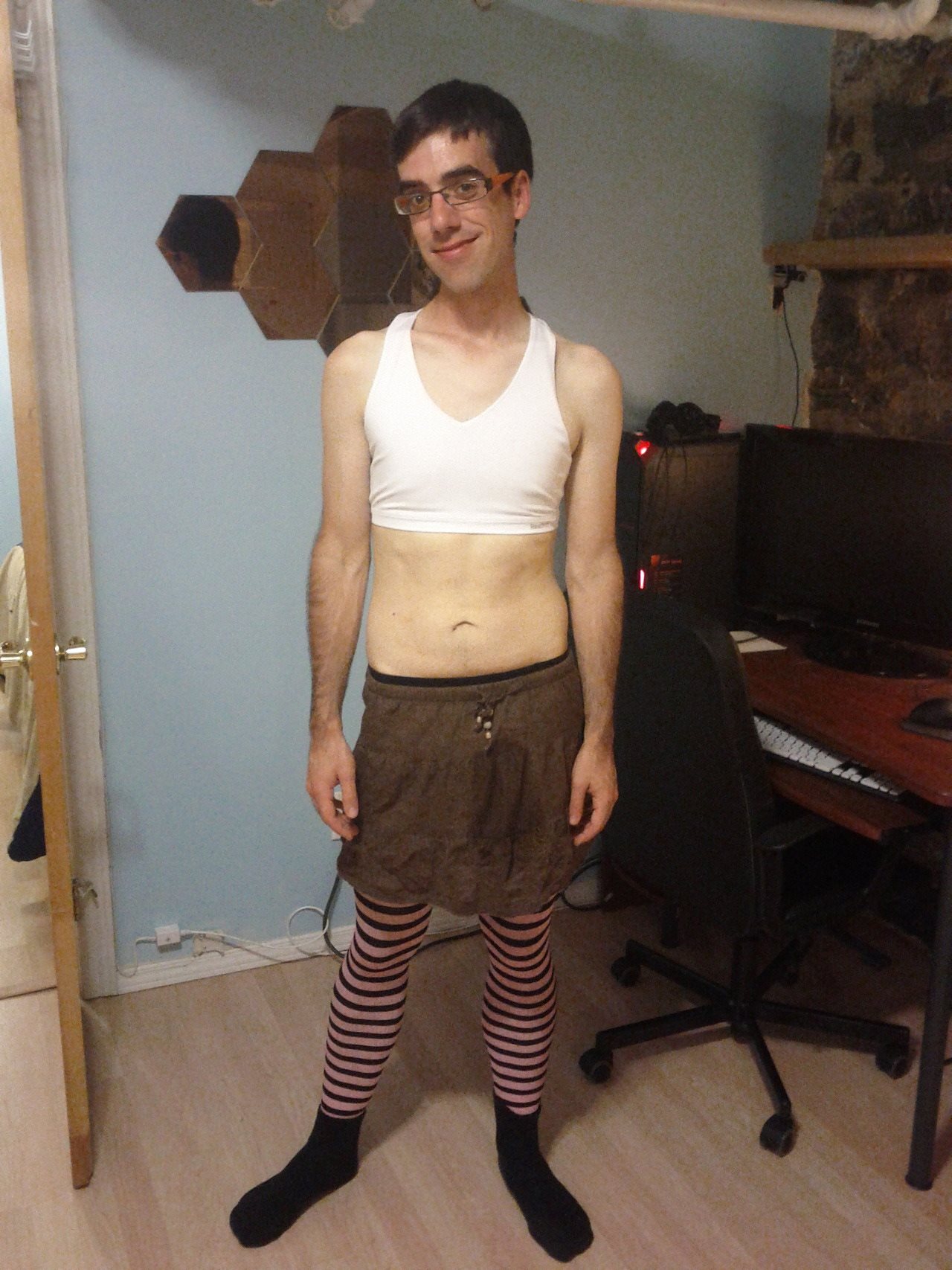
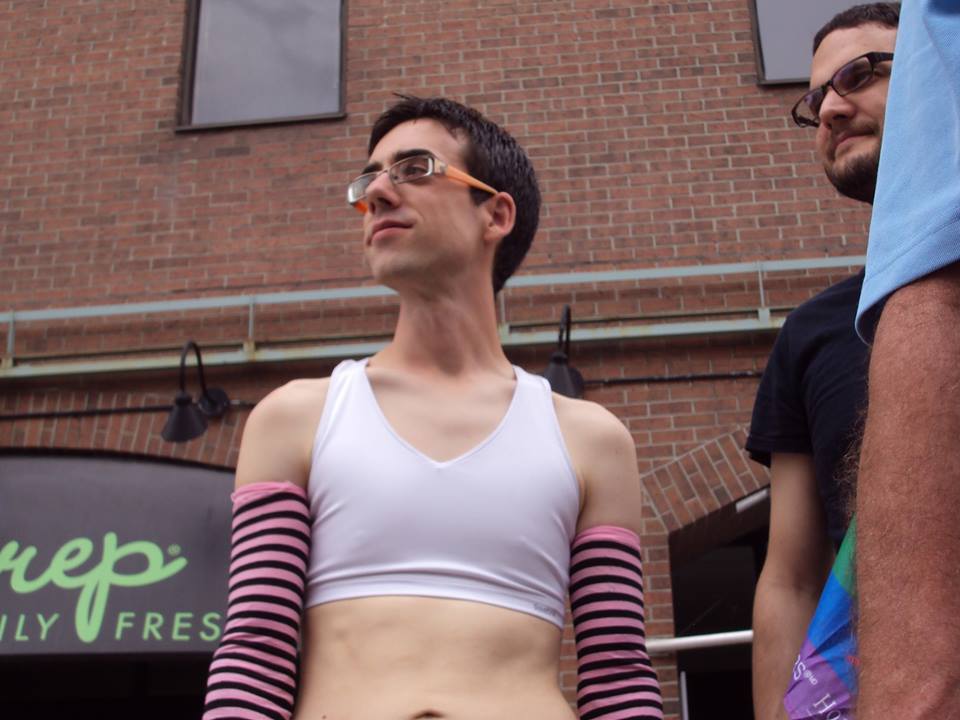
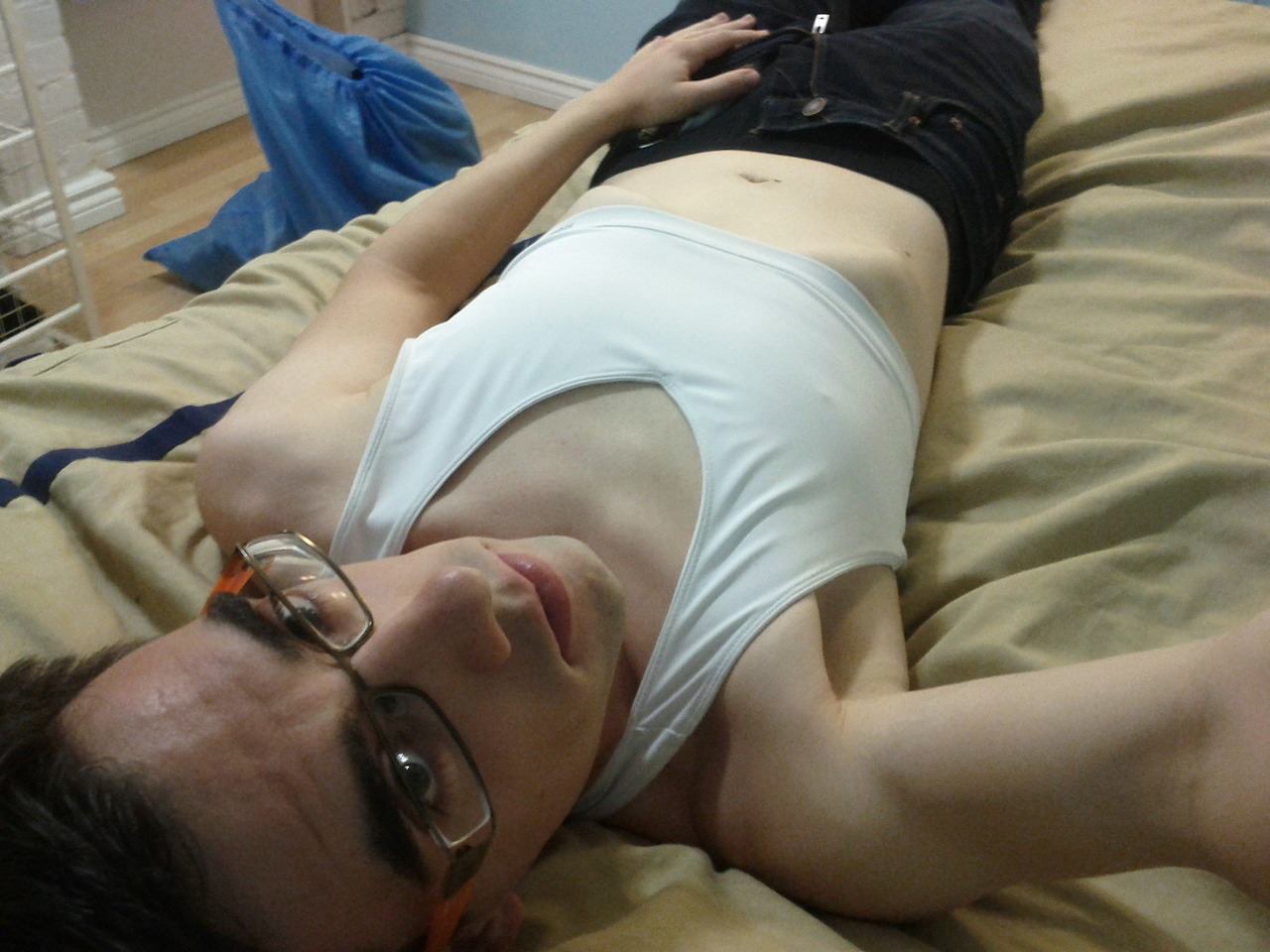
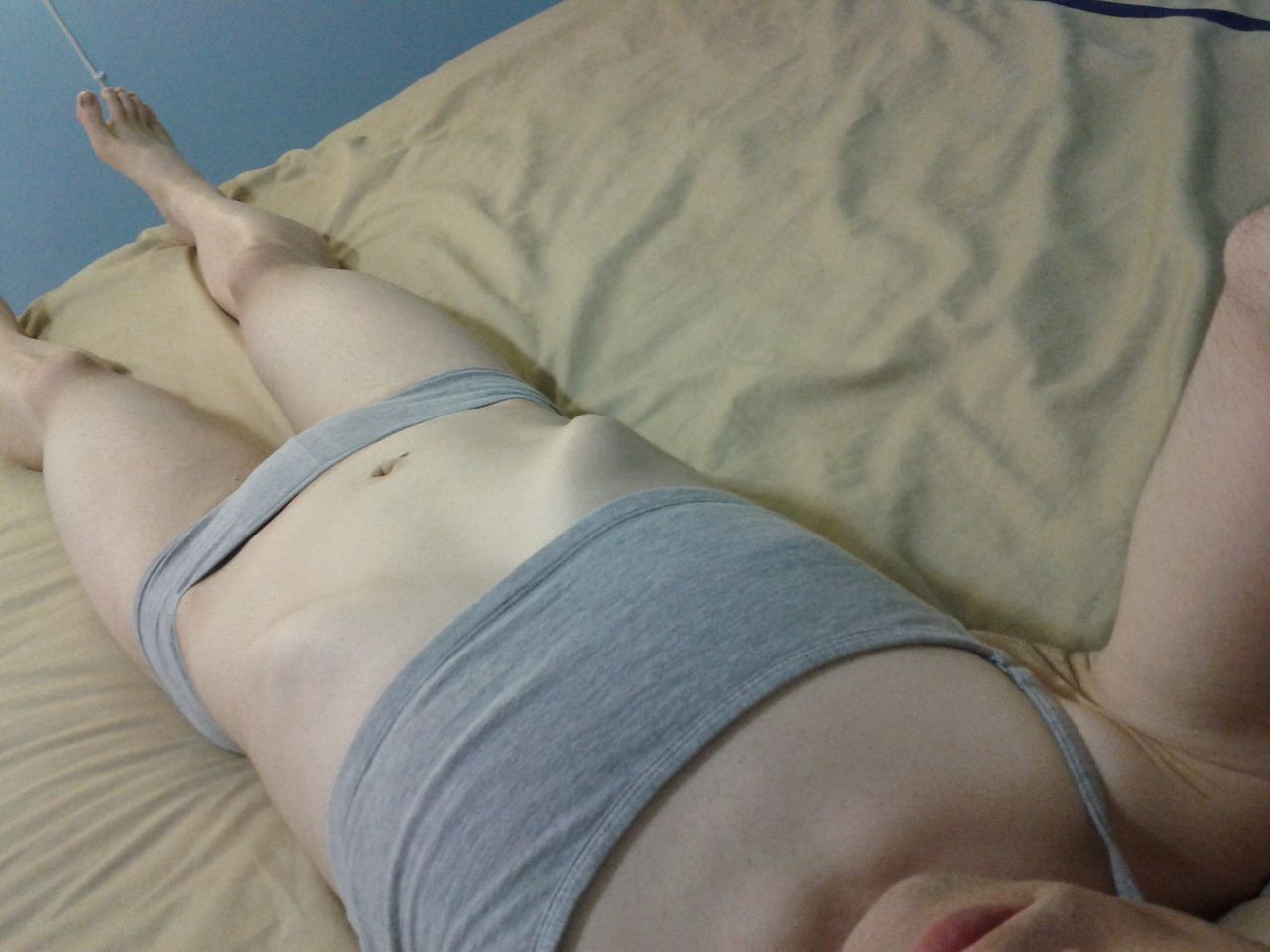
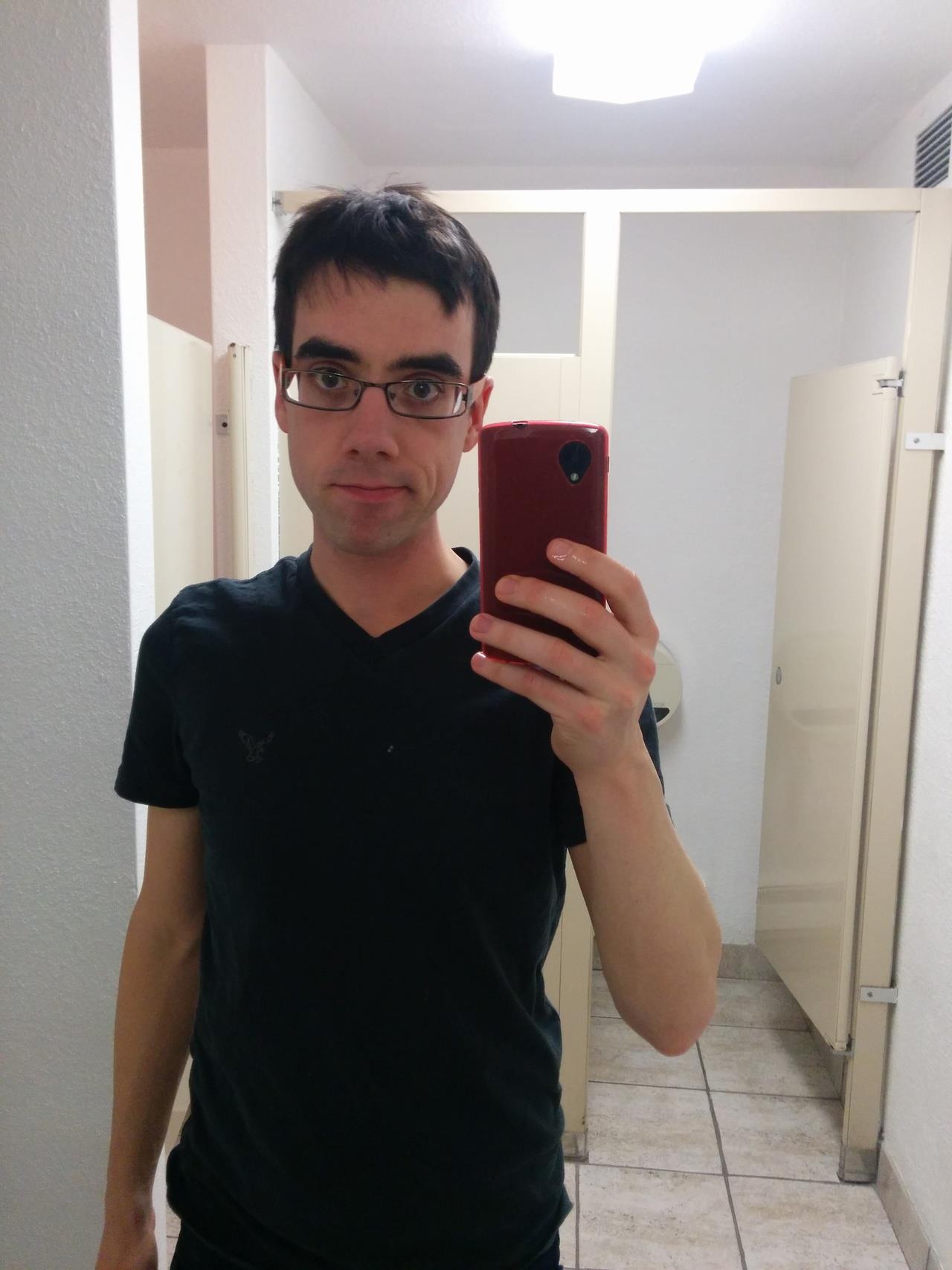
I documented by evolution in 2013 with the following explicit selfie essay:
January: Tucking whenever my crotch is visible.
February: Realize that while I strongly dislike using my own junk, I’m really fine with using a strap-on.
April: Start to bind. Can’t explain why at the time.
August: First bra.
August: First bra bought without having someone there with me.
August: First skirt. Ignore the stain.
August: First public outing in girl mode. Photo credit goes to Eliot Waddingham.
September: Start shaving legs, then eventually arms.
September: First gaff.
December: First time in women’s washroom.
That I’m topless in most of these has to do with my never having been comfortable with my body before this point and finally embracing it. Part of that had to do with my body-image issues around weight, but also the dysphoria I hadn’t been aware that I was carrying until it started to dissolve with transition.
Through this two-year stretch I legally changed my name, changed my sex marker on my driver’s license and health card (still waiting for those in the mail), movedtwice, dropped out of school, quit a suffocating job and went to work for a start-up, came out to my immediate family, my friends, and to work. I froze my sperm. I nuked my Facebook and Tumblr profiles. I went low-contact with my parents and as it stands they do not know where I live.
I eventually started hormone-replacement therapy. It’s been five months now and there’s been noticeable changes. Breast growth – I’m perhaps an A now. My hair isn’t greasy in the morning anymore. I’m no longer producing semen. I’m still exclusively read as male in public, but my comfort with my body has grown to heights I never thought were possible.
The last two years in particular have opened my eyes. I thought I understood what transphobia looked like. I went to a trans march three years before I came out. As it turns out, I had no idea. It wasn’t these overt display of hostilities, so much as the constant grinding away of people by those with power over them. I became interested in communicating part of those difficulties to the sexist/transphobic/homophobic eighteen year old me. I wrote a fewpieces.
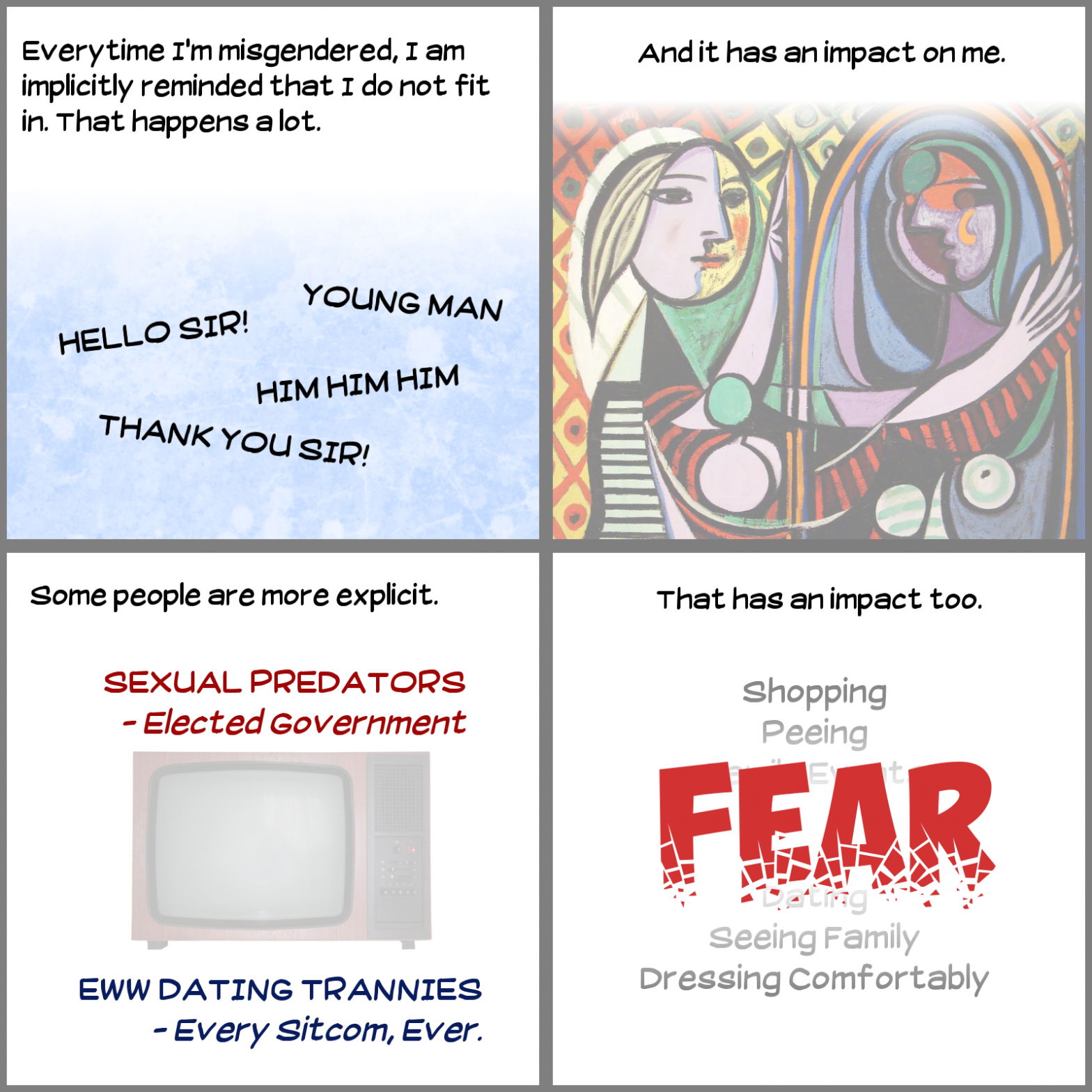
I also made the comic below. It doesn’t speak to the institutional difficulties, because I’ve been lucky. My friends have dealt with schools refusing to change their name, causing them to be outed to their class and not wanting to be there. They’ve dealt with provinces that said they couldn’t change their ID without undergoing surgery – even if there is no medical need for that surgery and they don’t want it. Not being able to change their ID means that they’re outed every time they show it. That makes getting jobs that deal with vulnerable peoples, which is what they went to school for, impossible. Being outed still means being treated very poorly in so many fields. There are so many stories of them turning to higher ups in each of these institutions for assistance, only to be met with resistance and things not changing.
Anyways here’s that comic, my latest attempt to communicate my thoughts on tranphobia:
I’m scared that some of the most wonderful people I’ve come to know won’t be here in five years.
They share stories of abuse and I bear witness to a creeping apathy to life. I see them become numb to the words of kindness from those who love them. I see those who love them feel so small because they know they lack the power to make it right.
Life is slowly bled out through mundane interactions, each seemingly too insignificant to act upon.
Simple tasks are hindered at every step. Walking outside. Attending school. Going to work. Seeing family. Hanging out with friends. Shopping for clothes. Going to the washroom. Interacting on social media.
Looking between myself and my friends in the last year, there’s been regular street harassment, multiple assaults, continued parental non-acceptance, denied medical care, denied access to education and employment discrimination. I live in a world that hurts some of the sweetest most gentle people I’ve ever known because of the minority to whom they belong.
You don’t have to know my friends to know this is going on. Just look at the environment we live in. Our government likens us to sexual predators. Both national newspapers blast our acceptance. Multiple provinces force trans people to undergo sterilization. Our local publicly funded schools ban projects that talk about us. Our religious leaders publicly admonish tolerance of our existence. Entertainment ridicules us regularly; I see transphobic remarks in television and film about every two weeks. This is all right now in 2014 and it informs how people are to treat us. The result, the predictable outcome of life being made impossible to live, is that we’re dying in large numbers in Canada.
I’m tired. I’m tired of seeing individuals use their authority to encourage this violence towards us. Not that they’d even recognize it as such. Our gender was never real to them so any harm that comes to us from undermining that is seen as self-inflicted. I’m tired of these actors being so quick to wish hardships on others that they’ve never known themselves. I’m tired of all the fellow party members, editors, family members, administrative staff along the way who could have stopped them but chose not to. An action unto itself.
I’m tired of seeing them spew their deadly vitriol under the pretense of fair debate and religious freedoms and find everyone be seemingly satisfied by these empty arguments. I’m tired of all those who stand silent now knowing they will one day turn around and insist that they stood with my friends all along. Who will believe it’s coincidence that they only spoke out once it became fashionable and a boost to their social standing to do so.
We’re taught to expect evil to be draped in hate. It’s not. It’s far more banal. Those who do this evil to us don’t hate us. They don’t even know us. All they’re running on is this image they’ve made up of us. Their prejudice is such that they have no interest in amending that image with reality. When conservatives want to find out about trans people, they don’t attend trans community events, consult those who work with trans people, or ask trans people about their lives. They turn to known hate groups who don’t know anything about trans people other than their own unrealized fears. They act against this imaginary foe. The fictitious nature of their opponent leaves no place to appreciate how real people are then harmed. They continue to engage in evil because imaginary foes never go away. Imaginary foes are always strong and immune to harm, not the weakened gentle souls of my friends.
Sometimes evil is even more mundane. It takes the form of apathy. Where people with power over our lives believe their own life experience to be universal and therefore regard any particular action on account of our differences as an unreasonable imposition. They wouldn’t have such needs, so why would we. Existing barriers consequently remain firmly in place; to employment, to education, to medical care.
I feel so powerless. After all, what can I realistically achieve. I can just pick up the pieces after the harm’s been filtered down to the realities of the every day. Console my friends, visit them in hospital, make them dinners at home, talk to already sympathetic politicians, write blog posts to the audience that needs it least, and chant in marches that only those who attend will remember.
I just love my friends so much and I’m tired of seeing them hurt over and over. I guess saying “please stop hurting these wonderful kind people” wouldn’t mean anything huh.
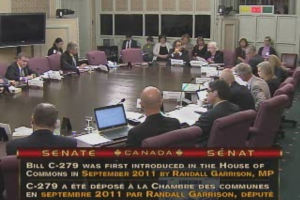
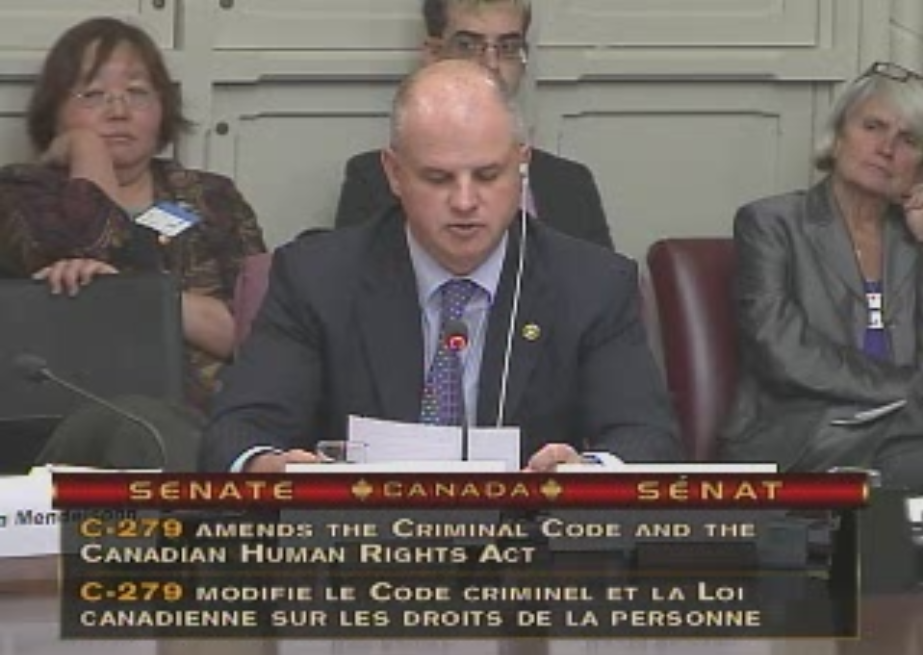
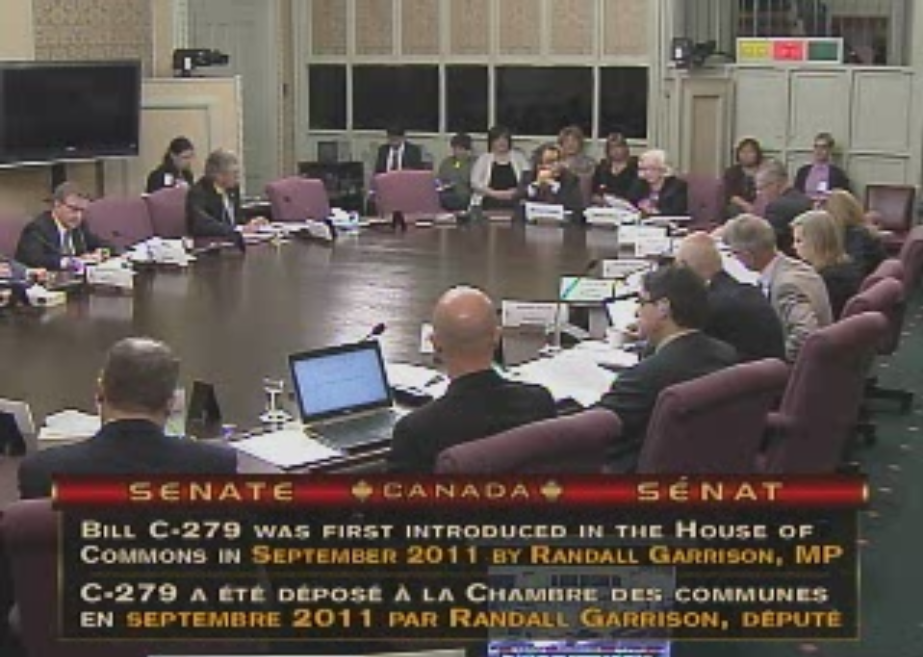
Last Thursday, I attended the meeting for the Senate committee on Legal and Constitutional Affairs. On the agenda was Bill C-279, An Act to amend the Canadian Human Rights Act and the Criminal Code to add protections on the basis of gender identity. The plan was that I’d work from home from 5 AM until 9 AM, head over to the Parliament for the 10:30 AM meeting, and then return home at 1:30 PM to finish off the work day.
This was the second such meeting by the Senate, the first had taken place the week previous and I had watched the proceedings online. What was particularly striking for me in that first meeting is that none of the people involved in the discussions about trans people, including the witnesses, were trans. The bill’s terminology is “gender identity”, which I equate to transgender. Explicit protections for all other forms of gender variance, including genderqueer and non-binary identities, were removed at the behest of the Conservative party. That was the “gender expression” terminology.
I said that the lack of trans people was striking. What also stood out was how absolutely ignorant the two witnesses were on the very subject of the bill.
“We know that transgendered individuals, 95% of them are male…”
-Witness from the first meeting
For instance, one of them stated that 95% of trans people were “male”, by which they meant trans women. The absurdity of that figure would have been immediately evident to anyone a rudimentary knowledge of trans people. The misgendering was further indication that they’d never been acquainted with a trans person. It made me believe that their opinions weren’t rooted in expertise on these matters, but rather unsubstantiated fears.
Neither witness stood up for trans people, and the leading Conservative’s arguments in opposition of the bill were horrific. If we protect trans people, it was argued, then we’re protecting child molesters. This in a country where 26% of trans people are assaulted, where 40% attempt suicide due to a hostile environment, and where 74% of trans youth reported being harassed. The NDP sponsor of the bill made a great speech at the beginning and contested this bigotry but the mood was set.
“Apparently 0.3 percent of the people in our country are trans. Are we not infringing and trumping people’s rights by giving trans people the right to go into these areas?”
– Conservative senator during the first meeting
I decided I would show up for the next meeting, so that when these people spoke, they would at least see the faces of the people they’re equating with sexual predators. I would put on a skirt as they would otherwise believe me to be a cis male, undermining my purpose of being there.
I showed up on Parliament hill quite anxious. I wasn’t too sure of the protocol, if I had to have contacted the clerk before hand for some kind of clearance. Nope. Just literally walk up to the right building, sign in at the front desk, and make my way to the right room. I ran into people I recognized from Gender Mosaic and introduced myself.
I arrived and took my seat next to a woman. We talked a bit. She explained that she had been “transgendered” but later had changed her mind. She opposed the bill as it could mean that trans women might be able to use women’s shelters. Despite her own beliefs, I strongly question the veracity of her story. She believed stuff about trans people that would be among the first things to be dispelled if she had walked in their shoes for a day. The term she had for trans women was misgendering them, the awfulness of which would be understood if she had been trans or around trans people. It reminded me of how ex-gays talked. Nevertheless, we were both very kind to each other. I don’t think she caught on that I was trans despite the skirt. I tried to let her know that the reality was the reverse from what she believed – trans people are way more likely to be assaulted by cis people than the other way around.
This second meeting had six witnesses.
One of them was trans. He was a youth that had just won a case in Ontario through protections enshrined in the province. He relayed his story, which Maclean’s had covered in an article:
For Thompson, an avid hockey player now in Grade 12, the issue became acute about four or five years ago when he hit puberty.
“I’m just a boy. I’m just like any other kid out there growing up. I’m just a teenager,” he said.
“(But) once you get to a certain age, you are forced off into a different room, or basically a closet — sometimes they didn’t even have change rooms for girls.”
Thompson’s mother, Ailsa Thompson, said it was “very upsetting” when a coach booted her son from the boys dressing room on the basis that “she’s a girl.”
Other parents could also show a lack of understanding, she said.
“Parents would come in and kick Jesse out of the girls change room because it was for girls only.”
These attitudes made it very difficult for him to enjoy the sport that had been a significant part of him. The other witnesses were from EGALE, from the right-wing REAL Women of Canada, from the Canadian Civil Liberties Association, from the Ottawa Police Services, and a lawyer representing himself.
If the mood of the last meeting was of opposition, this was of support. All the witnesses safe for the one from REAL Women of Canada were supportive of the protections suggested by the bill. The lawyer had been brought in by the conservatives, but he too turned out to favour the bill. The Ottawa Police Services, who are respected by the right-wing, were in support of the bill. Meanwhile, REAL Women of Canada made some pretty horrific statements – but it was actually not any worse than what the leading Conservative had already said. That undermined its effectiveness but it did not deter the Conservatives. To my surprise, they did not alter the arguments from the last meeting.
They equated trans women with sexual predators. To validate this, they brought up three individual accounts of sexual assaults. The Conservatives were using the actions of perpetrators who might not have even been trans to portray an entire people as a potential threat and undeserving of protections. That was really ugly rhetoric to witness. At one point they argued that it was a matter of competing rights. It was an infringement of a cisgendered person’s rights if they were not allowed to deny people access to spaces on the mere merit that they might be trans. The targets of this vitriol was exclusively trans women under various monikers including “biological males” or “transgender males”. Trans men didn’t come up at all, perhaps because they were seen as women and therefore not a threat.
What the Conservatives managed to do is to drive the conversation away from the subjects of this bill, the many thousands of Canadians who are trans, and focus on horror stories that had nothing to do with their lives. But it had everything to do with the misconceptions and fears that cisgender people have of trans people. As astute politicians, they had to have known that their arguments were untrue. The most populous provinces in this country have similar legislation proving those fears unfounded. The Conservative’s interests were not in the wellbeing of the subject matter. They were not interested in even hearing from a trans person and bringing them on as a witness, they only brought on those opposed to their recognizing their existence such as REAL Women of Canada.
The answer appears to be that the bill is intended to be interpreted by the human rights tribunals and the courts in order to extend its reach to a number of other problematic sexual activities, including pedophilia. That is, the broad definition of the expression, “gender identity”, included in this bill, will eventually have to be interpreted by the appointed human rights tribunal and courts to determine the meaning of these words.
– REAL Women of Canada Brief on Bill C-279
There were breaks between pairs of witnesses. In them the supportive politicians and lobbying groups in attendance mingled. Amnesty International was there, passing their latest document on the matter. Gender Mosaic was consulting the politician who had sponsored the bill. I got to shake hands, which was neat. I kind of stood out as seemingly one of the few not representing an interest group.
As the day progressed, the Conservatives shifted tactics. The questions led on that they were looking to make an ammendment to the bill. Either by including protections on the basis of sex or by removing the definition of gender identity. The original bill had no definition but the Conservatives insisted one be put in in order to get the few votes they contributed for it to pass the House of Commons. If an ammendment were to go in the bill now, however, it would die. It would be sent back to the House of Commons and not be passed in time for the next election, killing it. This would be nothing new – the two previous incarnations of this legislation died in such a fashion. This had been going on since 2005. It was clear that the Conservatives would try to kill this bill through any means possible and this was a very clever way to go about it.
If I focus on the Conservatives, it’s because they’re the reason why this bill has yet to pass. Why any witnesses were there. Everyone else was in support. This spectacle was for them.
If this bill dies, so too will many people. That 40% suicide rate should be counted into the statistic of how many trans people are violently killed. Many of them would still be here if it wasn’t for this environment so hostile to their existence. Bills of this nature are no panacea but they are progress. For one it means that the federal government would no longer force trans people to undergo castration if they want their gender identity respected. It means that police services would start to track transphobic assaults. It also sends a message that helps facilitate a shift in attitudes.
As an aside, the woman beside me ended up playing another role in the proceedings. She had approached the Conservative senator the day before. During the proceedings he invoked the story of this ex-trans to legitimize his stance.
I came out of that meeting room with mixed feelings. Happy at the effective witnesses. Frustrated that EGALE had not selected an out non-cis person to represent them despite their candidate’s good performance and impressive qualifications. I felt that perhaps someone who was out and trans would have been more adept at bringing things back to the bigger picture. I was also impressed with Noa Mendelsohn Aviv from the Canadian Civil Liberties Association.
I ate lunch downtown, came back home, and went back to work.
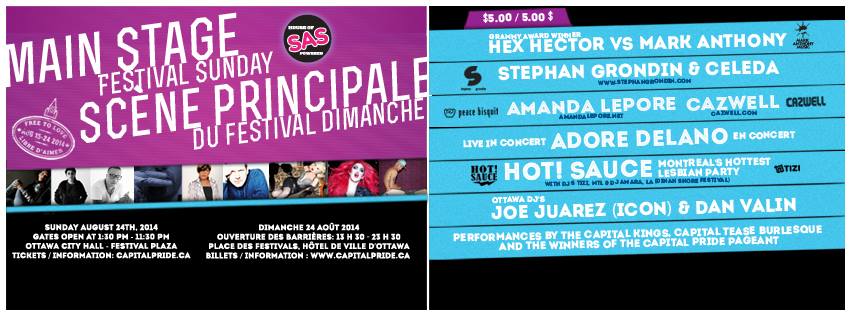
I think Ottawa’s Capital Pride serves as a good case study on the mechanics of prejudice.
Capital Pride purports to represent the interests of the queer community in Ottawa and Gatineau. In practice they only serve white, upper or middle class, able-bodied, working-age, anglophone, cisgender gay individuals. For the purposes of this article, I’ll shorten this latter group to cisgays, but know that when I use that term I mean all of these qualifiers.
In this article I’ll focus on Capital Pride’s prejudice against trans people, people of colour, and francophones. I would assert that participation by these communities is despite of, rather than due to, the board of directors for Capital Pride. Though their exclusion is well-known to members of these communities, I will nonetheless substantiate these claims.
The Theme
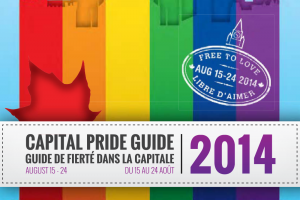
The theme for Capital Pride this year is “Free to Love.” It is focused on sexual orientation to the exclusion of gender-related issues. It speaks to the attention by cisgay activists to issues abroad this year, in particular Uganda and Russia. It also speaks to a general lack of awareness for queers at home. There is a perception among cisgays that Ottawa-Gatineau is a done deal.
This is substantiated by comments made by Jodie McNamara, the chair of Capital Pride:
After last year’s record-breaking attendance of 75,000 spectators, the Parade will once again march down Bank Street through Ottawa’s LGBT Village on Sunday, August 24 under this year’s theme, ‘Free to Love’. ‘Free to Love’ is about celebrating the rights and freedoms that many of us in Ottawa enjoy, while standing with those for whom the struggle continues.
This talk of “standing with those for whom the struggle continues” is not referring to others in the area. It’s talking about people abroad. The fight in Ottawa is thought to be over.
Just this week both of Canada’s national newspapers published pieces portraying trans people as delusional and a threat to children. Barbara Kay of the National Post wrote the article Transgendered advocacy has gone too far, railing against acceptance. Margaret Wente of the Globe & Mail wrote an article entitled The march of transgender rights. It’s concluding paragraph sums up the sentiments within quite well:
But today, people demand affirmation for their “personal truth,” no matter how distorted that truth might be. Transgenderism is not so much the “next civil rights frontier,” as Time magazine declared it, as a way for intimidated liberals to declare their bona fides. Enough is enough. And for God’s sake, leave the kids alone.
Both newspapers are seen as authoritative and the pieces they published will perpetuate the misconceptions that feed the violence faced by trans people. Yet to the likes of Capital Pride’s Chair, there is no problem here.
That ignorance extends beyond the personal beliefs of the organizers. It constricts all the rights-oriented discussions that would occur during Pride. The mandates that Capital Pride put together do not allow the space to have these local marginalized voices heard. The events are to explicitly focus abroad.
The description for the human rights vigil:
This year’s vigil will look at what it means to be “Free to Love” around the world, and will be hosted by special guest Stephanie Battaglino.
The description for the awareness-raising conference:
This is a free event that plays off the festival’s 2014 theme, “Free to Love”, and will feature Stephanie Battaglino as the keynote speaker.
The speaker at both of these, Stephanie Battaglino, is a corporate vice president at a large American insurance company. She will have no knowledge of the context in this area.
If the ignorance is this lack of awareness for the plight of queers in Ottawa, the prejudice is silencing these voices by assembling mandates that make them unwelcome.
Capital Pride Marginalizes Francophones
Capital Pride’s mission statement states that it represents the Ottawa-Gatineau region. There are approximately 314,000 individuals whose mother tongue is French across both municipalities. This does not include the higher number of whom speak French but don’t have it as their mother tongue. Many are not fluent in English.
All 45 of the 45 events at Capital Pride will either be unilingual English, or in English with a French component. 0 of the 45 events will be unilingual French. Anything of substance will only be offered in English. The speech by Stephanie Battaglino at the human rights vigil will only be in English. Her keynote at the conference will only be delivered in English. There will be no translator. Three of the three panels at the conference will be conducted in English. Six of the six films presented are either with an English audio track, or if they’re in a foreign language, given English subtitles. There will not be French subtitles available for films whose audio is not in English. The one discussion group will only be conducted in English.
So what’s in French? The latter half of the guide, which describes these English-only events. The French portion is a translation job, given that there was no original content in that language. The translation is sometimes done with comically poor results. For instance:
Portez vos vêtements en cuir et votre engin de fétiche avec Fierté!
This, along with a token few words in French at a flag raising and introducing the next musical performer at one event, constitutes what Pride organizers believe to be accessibility. This view was affirmed in an article by the Ottawa Citizen a few years ago entitled “Pride party adds francophone flair”:
”For a long time, a lot of francophones and people of Gatineau have not had a lot of queer-oriented events,” Capital Pride spokeswoman Lauryn Kronick said. ”It’s pretty sad that there’s a lack. We want to make it more accessible so that francophones will come out and not feel as though they’re being neglected.”
This year’s official Pride Guide is available in English and French, there will be more francophone performers and MCs will speak in both official languages, Kronick said.
This year, every single performer will do their act in English. But the MCs will introduce them in both official languages.
It is ignorance to entertain the idea that describing unilingual English events in French in the guide constitutes accessibility. Or that having stating the name of the next all-English performance in French makes it accessible in that language. It is also ignorance to think that making an event that excludes a third of the local population by virtue of an accessibility barrier is anything short of prejudicial.
Racism, Transphobia, Fat Shaming in the Guide
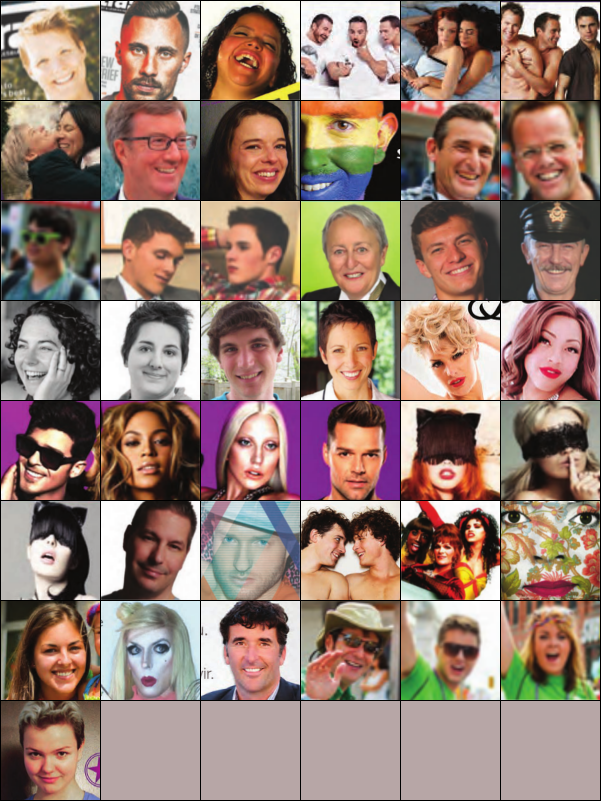
There are other cues that speak to who an event is for. Some of them are not in words, but images. I’ve compiled a list of all the faces more than a few pixels wide found in the guide Capital Pride distributed for 2014. I omitted the faces of five young children which were accompanying their (white cisgay) parents. That leaves 52 faces.
The organizers of Capital Pride’s mission statement is:
The mission of the Capital Pride Festival is to perpetuate the spirit of pride in the gay, lesbian, bisexual, trans, two-spirited and questioning (GLBTTQ) community in Canada’s National Capital Region of Ottawa–Gatineau.
Some observations:
0 of the 52 people are actually trans.
2 of the 52 people are fat. It would need to be 27 people to accurately reflect Ontario.
2 of the 52 people are queer youth.
4 of the 52 people have grey hair.
4 of the 52 people are of colour. It would need to be 12 faces to accurately reflect the diversity in Ottawa.
52 of the 52 people are presented to be able-bodied.
Also:
There are 7 drag queens but 0 drag kings.
There are more straight cisgender male actors depicting trans people (1) than actual trans people (0).
Note: The exact figures are not known. I based the above on making assumptions about each face. Please see update #3.
In short, the organizers have put together a guide that replicates the racism, ageism, ableism, toxic beauty standards and cis-sexism that exists in society.
I think it bears mentioning again: in an event that purports to represent trans people as one of the six identities explicitly mentioned in its mission statement, Capital Pride’s booklet with fifty-two faces did not include a single trans person.
The bias favours one specific group: white, thin, middle to upper class, able-bodied, working age, cisgender gays. If the guide accurately reflected the diversity in Ottawa, there would be three times as many people of colour. Instead, those faces are replaced by white people. If it accurately reflected the queer community, there would be a number of trans and genderqueer folk. Instead, it’s even more gay men and women.
Representation is important. It’s messaging about who is actually welcomed, the results of good words put to practice. The faces in the guide are about who organizers envision as being part of Pride. Right now, that vision is one without people of colour, fat people, trans people, or people with disabilities.
One could pass off the prejudice as mirroring the bias’ of its corporate corporate sponsors, as most faces come from their advertising. However, Capital Pride’s own record fared no better. Representation in the portions where Capital Pride had full creative control was worse than the corporate advertisements.
Incentivized Against Accepting Marginalized Queers
If prejudice against marginalized queers is embedded throughout Capital Pride, it does little to help that it is incentivized against their acceptance.
This is a consequence of Capital Pride’s dependence on corporate sponsors and positioning itself as a city festival, both of which rely on public approval.
It wasn’t always the case.
When Capital Pride had its inaugural event in 1986, it was a celebration for this society’s most reviled. Public approval was not a requirement.
This was at a time where gay bashings were a fact of life. Where police conducted mass arrests of gay people. Newspapers ran fearmongering pieces. It was twenty years before same-sex marriage. There was little public support and no major company wanted to be associated with that kind of movement.
Pride was a beacon in all of this. Pushing acceptance.
The dynamics are different now. Corporate funds do not come without strings. It means Capital Pride does not want to risk pitting corporate brands against public opinion by proxy through their association with people that society does not like. It means less leverage to oppose prejudiced representation in advertising. It should be noted that corporations never lead public opinion on matters of acceptance. This is as a principle of financial self-interest. Capital Pride’s dependence on them thus curtails the organization’s capacity to lead the way on matters of acceptance. That also ties in with Capital Pride’s relationship with City Hall, which again is sensitive to public opinion as a matter of political survival. There is a reason why Capital Pride would never allow the voices of the marginalized, like sex workers, to front public facing events like flag raisings.
Given it’s history, it’s a most unfortunate evolution.
Nothing About Us Without Us
Capital Pride only organizes to serve cisgays. They speak of inclusion, but their actions demonstrate otherwise. Talia Johnson has a quote I very much find relevant:
Many people in these communities see themselves as being accepting and inclusive, but when one looks at the situation in more detail how they see themselves isn’t necessarily the reality experienced by the people who are supposedly accepted and included. When this disparity of thought and experience is pointed out the first response on the part of the community is often defensive, “of course we’re inclusive and accepting, see, we say so in our welcoming statement!”
Marginalized queers have been speaking out against Capital Pride’s exclusion for years and offering paths to move forward. Take for instance the article Ottawa Pride Invisibilizes Trans People, published in 2008. The board of directors have ignored these voices while maintaining they’re inclusive.
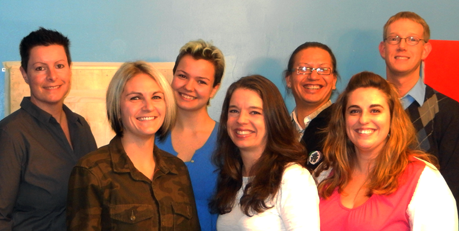
This brings me to the last thing I’ll examine for this article. This is the board of directors for Capital Pride:
Six out of seven board of directors are white. Seven out of seven board of directors are middle class. Seven out of seven are able-bodied. Six out of seven are cisgender.
They are not recipient to the kind of prejudice they facilitate. None of them stand to benefit from making their event more accepting. It is more likely that they would see it as a net loss. There are no voices of marginalized people on the board to raise those interests. The representation problem then is not limited to faces in the guide, but extends to the make-up of the organization itself. It becomes easier to understand why Capital Pride is prejudiced and only serves cisgays. It is a sad reality that this same prejudice places obstacles for marginalized queers to take on leadership roles, further inhibiting the removal of those barriers.
Conclusion
This is not an article on how Capital Pride can move forward to be more accepting.
It will come to be more inclusive in time, but not be because it led people there. Rather, it’s tied its own hands so that it can only trail the march of progress.
It’s unfortunate that there is such a fantastic opportunity for awareness raising that is being squandered away.
Pride is dead but it’s reputation lives on. I see it every time a baby queer wants to go to their first parade. It’s still important.
Will I participate in the festivities?
Probably.
There’s not a lot of alternatives out there.
Update #1: This article has generated a bit of activity in other places. In particular, it’s being misconstrued by some cis gays as an attack on their identities. This is a discussion on the desire to see inclusion at Capital Pride match its own mission statement. Identifying the ways in which it fails to do so is not an attack, nor is having a more diverse Capital Pride that treats others as well as it does them.
Update #2: I said that seven out of seven board of directors are white. The correct figure is six out of seven.
Update #3: A criticism has been brought forth that I passed off the figures on the identities represented in the guide as fact, when instead it was based off of assumptions I was making on each face. I find that criticism entirely valid. There is a representation problem that is immediately visible in the guide and I was trying to put numbers to it. The approach I took relied on assumptions that were rooted in my own bias. I could have erased someone’s identity. I apologize if I did so. Were I to re-write this article I would handle that section differently.
An acquaintance wrote a good piece the other day that discussed how violence was just another part of her everyday like brushing her teeth. She begins:
So I’m playing a nice relaxing puzzle game online, trying to be a little less depressed so I can study for finals, and I happened to glance over at the chat board attached to the side of the game, and people are making jokes about “mutilating trannies.”
“That’s me,” I think. “They’re talking about torturing and killing me.” Then, I keep playing my game.
This is a normal thing to happen to me. Being confronted sporadically with the idea of my death and dismemberment as a joke is my status quo. I’ve internalized it as part of my routine. If I made an (honest) list of my daily activities, alongside brushing my teeth and feeding my cat would be worrying about being killed, and then worrying that were I to be killed, whether the newspapers would call me a man. When I get out of bed and groggily pull on a cami, I’m equally likely to think about getting a breakfast sandwich with extra bacon, and whether or not today is the day someone pulls a knife. I love pockets in dresses because they keep my hands warm and I can put pepper spray in them. I like bars, but I barely drink in public anymore because getting carded might mean getting raped. I budget for these things.
I wanted to talk about that fear. I’m so habituated as to barely mention it or have to think about it too hard.
It’s there though. I base hundreds of calculations around it each day. What I wear. How much I cover up. What section of the store I’ll visit. How I’ll peruse those areas. How I talk. How I walk. Which coffee shops I go to because of their bathroom arrangement. How I package explanations.
There’s this perception that what I fear are isolated acts of aggression. The strangers who shout slurs at me from the streets for wearing a pretty dress. My acquaintances who were refused service. The people who beat up my friend.
Such acts bear their mark. Were it a freak occurrence, it could be healed and relegated to time. But for every one of these gestures there’s ten weekly acts of micro-aggression to sustain it. Reminders of how I shouldn’t exist. They never cease.
Those greater acts of aggression are not then the isolated misdeeds of a lone perpetrator. They are instead a minor and entirely predictable leap from a society deeply hostile to trans women. A hostility so normalized that it goes unnoticed. It is this invisibility that grants people the latitude to believe that the perpetrators act without support.
In the end it’s not that single, small, leap to violence that causes me to live in fear.
It’s the entire package.
And it’s why I have a separate “for work” and “for living” clothes. Why I avoid medical care. Why I dread shopping in stores come summer when I won’t have my coat to protect me. Why I don’t go into some stores at all. Why I don’t ask for help when I do. Or try clothes on in change rooms. Why I selectively correct family and friends on pronoun usage. Why I avoid family events. Why I’m afraid to say anything back when someone shouts “fag” or “freak.” Why I don’t go out to the Byward market late when the drunks are out. Why I hold my pee in. Why I keep my hands as fists in my pockets. Why I avoid sitting at benches if there’s a playground nearby. It’s even why I chose this name as it lacked the gendered association that could out me.
Success in Perspective
We are in a period of success stories.
There’s a handful of trans people in pop culture now. They’re known for things other than being trans. Actress Laverne Cox plays a prominent character in television’s Orange is the New Black. Lana Wachowski most famously directed the The Matrix. Laura Jane Grace is singer guitarist for punk band Against Me! The teen television drama Degrassi had a central character who was trans. The weekly Canadian news magazine Maclean’s had a sympathetic front page piece about trans and gender variant children.
Meanwhile there’s legislation passing in provincial and federal jurisdictions. It was only fifteen years ago that major gay rights organizations like the Human Rights Campaign refused to advocate for trans people citing political viability.
We are in a defining decade and it’s the best it’s ever been. But best as compared to what. In some sense these are very pitiful things to call victories. A handful of people in the media. An interview where the subject isn’t dehumanized.
Even then, these moments remain underwhelming exceptions in a deeply hostile environment. It does little to change why I live in fear.
The Whole Package
So let’s go back to this idea of the whole package. I’m seen as unfit for this world.
I know the province I live in thinks of me as unfit. They require trans people to undergo sterilization in order to change their gender marker on their identification; to the detriment of those who will have to use them.
I know the medical establishment thinks of me as unfit. I’m infantilized. I need medication. I spent four months with someone deconstructing my motives just to get a referral to a doctor that might help me. The doctor then set out to do the same. It’s been over a year and I still lack a prescription. For surgical care, you have to wait two years, write out an essay for your motives, and go before a panel of doctors to defend yourself.
I know my religion of birth thinks of me as unfit. The Catholic church has been a vocal opponent of every non-discrimination and anti-bullying legislation inclusive of trans people. They forbid discussions of gender identity in their official support groups in schools. Teachers have reported experiencing fear in supporting their students. The church has been at the forefront of efforts to oppose adoption and same-sex marriage rights abroad and still speaking against it at home. It has ramifications for trans people.
I know my political representatives think of me as unfit. They say that I shouldn’t be allowed to use the washroom to pee. They say that I’m just a sexual predator that will go after little girls if I do. They nickname legislation “the bathroom bill.”
I know my newspapers thinks of me as unfit. The National Post and Ottawa Sun run stories that dehumanize me. They too think I shouldn’t be accepted. They too echo these thoughts that I’m a sexual predator. This is why I’m afraid to go pee.
I know film and television thinks of me as unfit. Those positive interviews I mentioned always elicit a flurry of excitement because they’re still so rare as to be cause for celebration. Rather, in most sitcoms and interviews, I’m told I’m not legitimate dating material. That anyone going out with me should be ridiculed. I’m just a he-she. A tranny. An Adam’s apple. Interviews rarely fare better, with hosts reducing guests to their genitals.
I know pedestrians think of me as unfit. They shout things to let me know. Comments they would never say to anyone else.
I know my work thinks of me as unfit. A coworker came up to me to talk about how their ex-boyfriend came out as trans. It wasn’t done in a context of support but rather how it was a freak thing. My words to help him be there for him were brushed off.
I know that the people on the dating site think of me as unfit. One told me I should just go sleep on the train tracks. The moderators make dehumanizing remarks about trans members in private. Mostly I’m just ignored.
I know my family thinks of me as unfit. I’m delusional. I know that I’ll be tolerated and loved but never accepted.
So I enter any public space knowing that the people I will deal with will be shaped by this toxic environment. They’re told I’m a sexual predator. That I should never be considered date material, only something to fuck or jack off to on porn sites. That I’m an aberration not to be accepted as I am. This is why I’m afraid.
Casual Violence
The perception is that assaults and murders alone define the violence we face. That the tacit support these aggressors receive up until their final act is simply valid expression. Passed off as fair debate. Religious freedom. Or comedy. That this support is normal and that challenging it is what would be intolerable.
The violence of this support system is not a hypothetical. It bleeds through every interaction and people die from it. Forty percent of trans people attempt suicide. We have the studies. We know that the reason so many die is because of the hostile environment.
When it’s one hand that kills us, they call it murder. When it’s a dozen, they call it suicide.
This is the violence.
To make people live in fear is a form of violence.
To make them die is a form of violence.
To inhibit them from challenging it is a form of violence.
Yet this violence is so well accepted that it’s just part of my everyday routine.