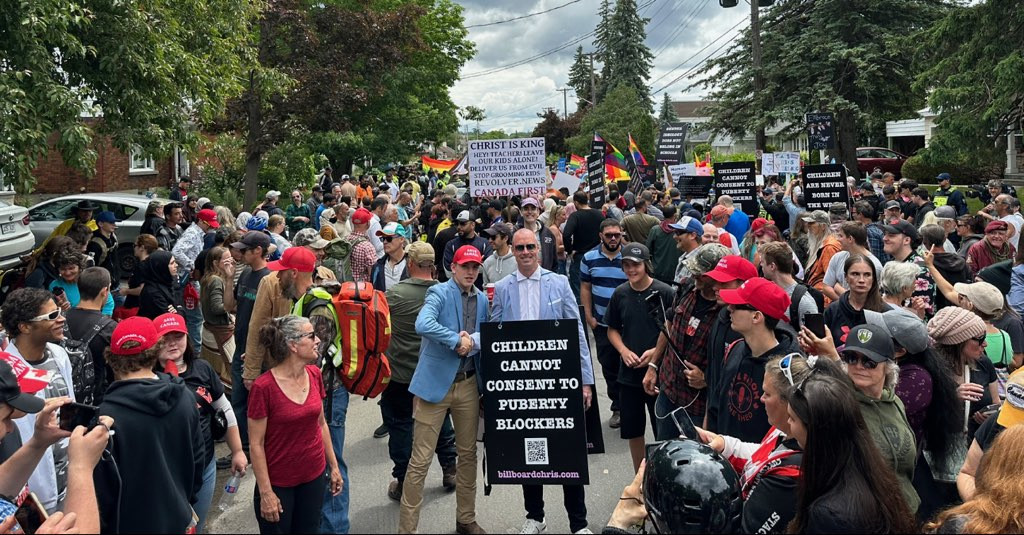
After sixteen years of talking to everyday people who participate in organized bigotry – from tea party rallies to the convoy to anti-trans marches – I’ve learned one thing: they don’t believe what they’re saying.
They think they do but here’s the test:
- Would they have believed that in isolation
- Can they defend it using their own words
- Will they ditch it on a whim
And to the media and politicians that loves to platform them but a single test:
- Do they omit that individual’s other wild conspiracy theories
Let’s break it down.
Would they have believed that in isolation
When I listen to trans people advocate, they express things in ways that are all their own. This is because their desire for change come from first-hand experience and while peers might have similar experiences, how they are interpreted is ultimately unique.
When I listen to transphobes litigate trans rights, I hear the same talking points on niche topics they know nothing of other than the phrases they’re parroting. If it wasn’t for the transphobic content they’re consuming, they wouldn’t think to speak on puberty blockers or whatnot.
That’s the first test: had they not consumed transphobic content, would they opine on these niche issues?
Can they defend it using their own words
Trans people know trans issues as more than throwaway lines. That means they can communicate about other facets of it, bring up closely related issues, and tweak their explanations for the benefit of a given audience. Transphobes lack the empathy and depth of understanding to do the same.
So then, the second test: can they defend their position outside of regurgitated talking points or invoking unrelated bogeymen like marxists?
Will they ditch it on a whim
Bigots are coherent in one respect: anyone who looks or acts different to the people they knew as children is repugnant.
This world coddles that immaturity. As I write this, one billionaire dad is spending a hundred million dollars on anti-trans ads instead of giving his trans daughter a hug. The current president of the United-States is a white supremacist. The media edifies that immaturity.
That also means their talking points are merely a vehicle to make the icky people go away. As soon as they falter, they jump to the next topic that can get rid of the icky people. Still they are earnest pushing these points, lacking the self-awareness to question this habit much less their discomfort with those who look or sound different.
That brings us to the third test: when facing overwhelming evidence disputing their talking points, do they sit with that information or immediately shift the goal posts?
Do they omit that individual’s other wild conspiracy theories
For the media amplifying these views and the politicians accepting their framing, a final test: do they neglect to mention the purveyor’s other batshit beliefs?
This won’t have been baby’s first anti-social conspiracy theory. They’re going to have some whoppers in there that the public and the people amplifying them are wise to.
So if politicians and the media omit this credibility-crushing information it’s that they don’t believe what the transphobes are saying either.
Maybe they also feel icky about gender non-conformity or it’s to get more engagement. Who knows but the problem was not with trans people or how they communicated. It was with the bigots, and here’s how you can identify them.
That and oh, the whole they’re transphobic thing.
Bonus tell: do they see the other group as visibly belonging in public?
When it comes to “debates” on minority rights, you end up with one side is arguing for inclusion in society invoking real situations where they were denied medical care, employment, and so forth. The other side is arguing to exclude a minority they don’t belong to or have even met from public view only invoking hypotheticals and distortions.
Out of it all, a bonus tell: do they want a future where they share spaces with visible members of the other group? Or is belonging predicated on looking and sounding like themselves?